Showing posts with label new covenant christianity. Show all posts

Wednesday, August 17, 2016

10 REASONS YOU SHOULD NOT TITHE


Here are 10 very good reasons to stop tithing your 10% every week.


  1. The command to tithe was given only to the Jewish people. It was intended to provide for the upkeep of the Temple in Jerusalem and to support the Priesthood who owned no land and did not work to support themselves.
  2. The Temple in Jerusalem is gone now and has been for over 2,000 years, since its destruction by the Romans in AD 70.
  3. There is no longer any need to support a priesthood made up of people who do not own land or work for a living.
  4. The Old Covenant is now obsolete according to Hebrews 8:13. Therefore no one needs to keep those laws anymore.
  5. If you are in Christ then you are now the Temple of God where He has made His home. [See 1 Cor. 6:19-20]
  6. Those who abide in Christ are automatically ordained into the Priesthood of All Believers. [See 1 Peter 2:4-5 and 2:9-10]
  7. The daily sacrifice that was once offered in the Jewish Temple is now replaced by the living, daily sacrifice of every member of Christ's Body. [See Romans 12:1]
  8. The New Testament scriptures do not command anyone to tithe and the Church didn't formally institute the tithe until 777 AD under Charlemagne. For over 700 years no one who followed Christ tithed anything to the church.
  9. The New Covenant standard is not 10%, but 100%. God owns everything, and we are commanded to surrender everything to Christ. [See Luke 9:23 and Mark 12:17 ]
  10. The early Christians only practiced a freewill offering, not a mandatory ten percent obligation. Just look at what Tertullian, a second century Christian, tells us about what the early Church did with their offerings:  
           “Even if there is a treasury of a sort, it is not made up of money paid in initiation fees, as if                   religion were a matter of contract. Every man once a month brings some modest                                   contribution- or whatever he wishes, and only if he does wish, and if he can; for 
            nobody is compelled; it is a voluntary offering…to feed the poor and to bury them, for boys                 and girls who lack property and parents, and then for slaves grown old…So we, who are                     united in mind and soul, have no hesitation about sharing property. All is common 
            among us- except our wives. At that point we dissolve our partnership.."

IN SUMMARY: 
No Christian today should continue to follow the Old Covenant mandate given to pre-Christian Jews to surrender ten percent of their income to their religious leaders. 

Now that everyone who is in Christ has been named the Temple of God, and has become the daily, living sacrifice, and has been ordained into the Priesthood of God, there is no longer any need to pay tithes to upkeep a building or to support a separate group or class of religious leaders.

Under the New Covenant, God owns 100%. We are called to surrender all that we have to Christ and to follow Him with our whole life. Under this New Covenant we do not relegate worship to one day a week, but we now seek and serve and worship Him every single day of our lives. 

So, stop holding back from God. Give 100 percent of your time, your money, your talent, and your life to Him.

Stop following rules and begin to follow the voice of the Spirit of God that lives within you.

Give freely, because you have freely received. [Matt. 10:8]

"Each of you should give what you have decided in your heart to give,not reluctantly or under compulsion, for God loves a cheerful giver." [2 Cor. 9:7]

-kg

FOR FURTHER READING

Tuesday, February 02, 2016

PLEASE STOP TITHING


If you are in the habit of calculating ten percent of your paycheck and writing a check to your local church, please stop.

God does not want your tithe. In fact, there's only one thing Jesus asks of you and it's called "Everything".

In the OT, God asked for 10%. In the New Covenant, God gets 100%.

"So therefore, any one of you who does not renounce all that he has cannot be my disciple." - Jesus [Luke 14:33]

The early church called this the doctrine of renunciation. Many modern Christians have reverted back to the Tithe, or "10 Percent" model, but Jesus asks for everything.

Did you know: The Christian Church didn't mandate a tithe until the 7th Century under Charlemagne? Imagine, over 700 years with no tithe? How could that be?

To begin with, offerings in the early church were voluntary and freely given out of love. Most gave more than a tithe (or "tenth"), instead many of them sold their property and shared what they had with those around them who were in need. This offering wasn't given out of compulsion, or due to obedience to a law or a command of the Church. No, it was freely shared out of spontaneous and sincere love.

"Freely you have received; freely give." - Jesus [Matt. 10:8]

Just look at what Tertullian, a second century Christian, tells us about what the early Church did with their offerings:

“Even if there is a treasury of a sort, it is not made up of money paid in initiation fees, as if religion were a matter of contract. Every man once a month brings some modest contribution- or whatever he wishes, and only if he does wish, and if he can; for nobody is compelled; it is a voluntary offering…to feed the poor and to bury them, for boys and girls who lack property and parents, and then for slaves grown old…

“So we, who are united in mind and soul, have no hesitation about sharing property. All is common among us- except our wives. At that point we dissolve our partnership.."


(An excerpt from his “Apology”, taken from “Roman Civilization Sourcebook II: The Empire, p.588)

Notice how they think of this offering:
*People give "modest contribution[s]"
*They give "whatever they wish"
*They give "only if they do wish"
*They give "only if they can"
*"Nobody is compelled" to give
*Offerings are strictly "voluntary", not compulsory 

Look at what they do with the money they receive:
*They "feed the poor"
*They "bury the poor"
*It belongs to "boys and girls who lack property and parents"
*And to "slaves grown old"

Note also that there is no mention of that offering being given to pay pastors or elders among them. Hmm...

Under the New Covenant, Christians are also set free from the idea of worshiping only one day a week, which was commanded under the Old Covenant. Now, under the New Covenant, every day is holy to the Lord. 

Notice that the New Covenant Christians met on only one day of the week - Every day:

"Day by day continuing with one mind in the temple, and breaking bread from house to house, they were taking their meals together with gladness and sincerity of heart, praising God and having favor with all the people. And the Lord was adding to their number day by day those who were being saved." - [Acts 2:46-47]

Under the New Covenant, our worship is a daily undertaking:

"Then he said to them all: “Whoever wants to be my disciple must deny themselves and take up their cross DAILY and follow me." - Jesus [Luke 9:23]

There is also no longer any one Holy Place where everyone must worship [ala the Temple in Jerusalem] because now WE are the living Temple of God, where He dwells by His Spirit.

"Or do you not know that your body is a temple of the Holy Spirit who is in you, whom you have from God, and that you are not your own? For you have been bought with a price: therefore glorify God in your body." [1 Cor. 6;19-20]


This is what we are called to.

Everything we own is God's. We enter the Kingdom by laying everything we own - our very bodies and souls - upon the cross, and then we set out daily to follow the crucified One.

When we see someone in need, we share what we have with them. If the Lord requires something from us, we let go and trust Him for our daily bread.

Because we know that the Lord will never leave us or forsake us, we can freely give - even as we have freely received.

This is what giving is like in the Kingdom. God owns much more than 10 percent. He owns 100 percent.

So, stop tithing, and start sharing freely whatever the Lord asks you to give, out of love and a sincere heart.

"Each one must give as he has decided in his heart, not reluctantly or under compulsion, for God loves a cheerful giver." [2 Cor. 9:7]
-kg

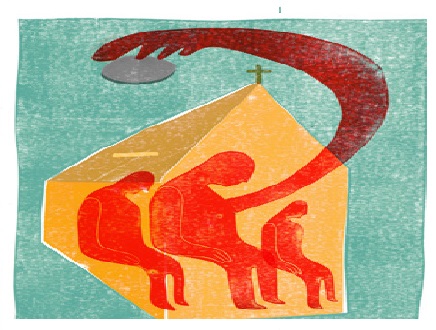
*IMAGE CREDIT: Scott Laumann

Tuesday, June 23, 2015

Anabaptists and Evangelicals: The Differences


By Nolan Martin

What are the distinctive beliefs of Anabaptists? The first difference, and perhaps the only difference many Anabaptists would mention, is their belief in nonresistance, which Evangelicals do not hold. 

Although this visible divergence is a significant difference, it springs from deeper doctrinal differences. The most basic of these differences lies in the interpretation of Scripture. Although both groups believe in the authority of Scripture and would even use similar methods to interpret Scripture, Anabaptists approach the Bible with some different presuppositions that lead to vastly different outcomes.

First, an Anabaptist interpretation of Scripture is centered on the teachings of Christ and his call to discipleship. The rest of Scripture is then viewed through this lens and interpreted so as not to contradict the teachings of Christ, the head of the church. This produces different conclusions than when interpretation is centered on the writings of Paul as often seen in Evangelical teaching. A Christ-centered interpretation maintains that Christ's teachings can be followed with God's enabling grace and must be followed if an entrance into the kingdom of God is to be gained. A Paul-centered interpretation tends to overemphasize man's sinful nature and makes man utterly helpless in the pursuit of good. Consequently, many of Christ's teachings are considered unattainable in the present. In fact, some who interpret the Bible this way postpone the validity of Jesus' teachings to some future time. God's mercy and forgiveness is emphasized in this system rather than careful obedience.

Second, Anabaptists believe the New Testament takes precedence over the Old Testament. They believe the Old Testament points forward to Christ, whereas the New Testament is the final and ultimate revelation of Christ. On the other hand, many Evangelicals have a "flat Bible," putting the Old and New Testaments on the same level. Except for Jewish ceremonial and dietary laws, Evangelical morality closely resembles Jewish morality. Oaths, accumulation of wealth, participation in war, and divorce and remarriage are acceptable for Evangelicals because they were acceptable in the Old Testament. For the Anabaptists, the New Testament teaching on these issues trumps the Old Testament teaching.

Third, Anabaptists believe the Bible is best interpreted when the believer is committed to obeying it. Early Anabaptists were concerned about how the learned of their day “twisted” the Scriptures to get around the force of a command. Anabaptists today reject the common distinctions made between New Testament commands on the one hand that are binding both in form and spirit upon Christians for all time and those on the other hand that are to be observed only in spirit. Many hold that to the former class belong such items as baptism and communion, whereas to the latter class belong such commands as to greet one another with a holy kiss, to wash one another's feet, and to anoint the sick with oil. Anabaptists hold that these New Testament commands as well as communion and baptism are to be observed by all Christians everywhere until the end of the age. Mennonite theologian J. C. Wenger said, "There is no exegetical consideration against the observance of feet washing, for example, which would not also bear against the observance of baptism."

Read more at:


Tuesday, March 31, 2015

The Anabaptists: Is Nothing Sacral?


Sometimes you read something that makes you stand up and cheer. That happened for me while I was reading “The Reformers and Their Stepchildren” by Verduin recently.

The book is an overview of the Anabaptists and the Reformers (Luther, Calvin, Zwingli, etc.) who violently opposed them.

In an attempt to explain why these Christians and their ideas were so aggressively resisted, the author points out something I am sure most people overlook; something that made me stand up and say, “Yes”!

Starting with Jesus, the author emphasizes the differences between “Sacral” societies and the revolutionary teachings of Christ. Namely, the idea that Jesus advocated for a radical ideology whereby men and women who differ – theologically, politically, etc. – can still live together in total harmony.

As he notes in the book, “This is one of the New Testament’s boldest innovations, the sweep of which will not escape the thoughtful.”

Now, what I find so exciting is that the author has put his finger on something that so many, many Christians today have totally missed out on.

He continues:

“It must not escape the reader that this was a novel insight, so novel as to be revolutionary. The world had never seen the like of it before. For all pre-Christian society is sacral. By the word “sacral”…we mean “bound together by a common religious loyalty.”…we mean society held together by a religion to which all the members of that society are committed.”

He goes on to point out that all other ancient societies were pre-Christian ,and therefore “sacral”.

As he illustrates so eloquently:

“The society of ancient Babylon…was a sacral society; all Babylonians were expected to bow to the one and the same “Object” (See Daniel 3); their society was pre-Christian.

The society of Ephesus was sacral; all Ephesians were expected to join in the chant: “Great is Diana of the Ephesians!”; (See Acts 19:28) Ephesian society of was pre-Christian.

In our own day, the society of the Navajo…is sacral; all members of that society are expected to take part in the ritual; theirs, too, is a pre-Christian society.”


And then, then, he drops the proverbial bomb:

“According to the construction of things, the Old Testament too was pre-Christian – as indeed it was in the chronological sense. Every member of the OT society was considered to be in the same religious category as was every other member of it. This makes the Old Testament society sacral and pre-Christian.”

Why is this insight so powerful? Because if those Reformed Christians had understood this simple truth, then the murder of the Anabaptists by their Christian brothers would never have taken place.

“…there would in all probability never have been a [persecution of Anabaptists] if the Reformers had been aware of the pre-Christian quality of the Old Testament in this matter. It was the Reformer’s refusal to admit that there is this perspective in the relationship that obtains between the two Testaments, it was their refusal to grant that the one had outmoded the other at this point, that caused the exodus of the Stepchildren (Anabaptists).”

Did you see that? Do you understand what he’s saying here? Because one group of Christians did not understand that the Old and New Testaments were fundamentally different – and that one of them (the New) had “outmoded the other” (the Old)…the bloody execution of Christians by their own brothers and sisters was set in motion.

Today we have much the same arrangement among followers of Christ. One group – the vast majority in this nation – hold the idea that both the Old and the New are concurrent and equally in force. Another group – in the small, but growing minority – understand that Jesus trumps Moses and that the NT declares the OT to be “obsolete” and “fading away”.

All that is missing is the power of one group to put to death the other group for daring to disagree on this point.

Based on the amount of hate mail and venomous comments left on my blog and FB page, if it were legal for those in the majority opinion to have those of us in the minority group arrested, tried and sentenced to prison or death, I would say that this blog would have been written from a jail cell on death row.

But, I digress. Getting back to the book, let’s wrap up the differences between the sacral perspective and the Kingdom perspective:

“It was because the Jews of Jesus’ day were pre-Christian, and therefore sacralists in their conception of things, that the problem “whether it is lawful to pay tribute to Caesar” seemed to them an insoluble problem. How could a man, they asked, be loyal to the political community by paying his taxes, without thereby being disloyal to the religious community, the Church? They, sacralists that they were, knew no answer to this question. It vexed them every time they tangled with it. And for that reason they confronted the Master with it, so that He too might be embarrassed by it and be hopelessly pinned in a corner. How great must have been their surprise at the ease with which Jesus, acting on the new insight He had come to convey, sailed through the dilemma with “Render unto Caesar what is Caesar’s and to God what is God’s”. In His way of thinking there wasn’t even any problem.

“As the thoughtful reader will have perceived, much is implied in this New Testament innovation. In it is implied that the State is a secular institution…It is implied in the NT vision that Christianity is not a culture-creating thing, but rather a culture-influencing one.”

Yes! This is where I could no longer contain myself and I jumped up to shout, “Yes!” in my living room.

The Church is not meant to be yoked to the State. We are not compelled to legislate culture through the courts or the law. Instead, we are commanded to communicate the radical Gospel of Jesus to everyone around us and to influence the human heart to submit to the rule and reign of Christ – regardless of what the Laws of the Land may be.

In that way, Christianity seeks to transform the culture from within rather than to legislate culture from above.

As the author notes:

“….there can never be such a thing as a Christian culture; there can only be cultures in which the influence of Christianity is more or less apparent. The NT vision does not pit a “Christian culture” against a non-Christian culture; rather does it introduce a leaven into any existing culture into which it insinuates itself, a leaven whereby that already existing culture is then affected.”

Amen!

-kg


Wednesday, April 30, 2014

Out With The Old. In With The New.


Which has more relevance for you:The 10 Commandments or The Sermon On The Mount?

Which one trumps the other: Moses or Jesus?

Does the question confuse you? Maybe so. “Aren’t they both equal in weight and value?” you might ask.

But think of it this way: Should we allow the Old Testament scriptures to inform our understanding of the New? Or is it the other way around?

American Christians have been lulled into an Old Testament form of Christianity. We’ve started to gravitate to a more Moses-centric form of Christianity rather than a purely Jesus-form.

If we’re followers of Christ, for example, why wouldn’t we want the words of Jesus on our buildings in public places rather than the Ten Commandments?

Imagine “Blessed are the poor for theirs is the Kingdom of God” posted in your Courthouse? Or “Love God with all your heart, soul, mind and strength. And…love your neighbor as yourself” displayed in our Town Squares? Wouldn’t that be more radical and “Christ-like” than a list of “Thou Shalt Not’s”?

But back to our previous question: Do we interpret the New Testament in view of the Old Testament? Or do we use the New Testament – and the teachings of Jesus and the Apostles – to help us understand the Old Covenant scriptures?

According to Paul, the Gospel is a mystery to everyone who came before Jesus. In fact, he says it four different times:

We do, however, speak a message of wisdom among the mature, but not the wisdom of this age or of the rulers of this age, who are coming to nothing. No, we declare God’s wisdom, a mystery that has been hidden and that God destined for our glory before time began.” (1 Cor. 2:6-7)


“In reading this, then, you will be able to understand my insight into the mystery of Christ, which was not made known to people in other generations as it has now been revealed by the Spirit to God’s holy apostles and prophets.” (Eph. 3:4-5)


“Now to him who is able to establish you in accordance with my gospel, the message I proclaim about Jesus Christ, in keeping with the revelation of the mystery hidden for long ages past, but now revealed and made known through the prophetic writings by the command of the eternal God, so that all the Gentiles might come to the obedience that comes from faith.” (Rom. 16:25-26)


“I have become its servant by the commission God gave me to present to you the word of God in its fullness— the mystery that has been kept hidden for ages and generations, but is now disclosed to the Lord’s people.” (Col. 1:25-26)

The Apostle Peter says it this way:

“Concerning this salvation, the prophets, who spoke of the grace that was to come to you, searched intently and with the greatest care, trying to find out the time and circumstances to which the Spirit of Christ in them was pointing when he predicted the sufferings of the Messiah and the glories that would follow. It was revealed to them that they were not serving themselves but you, when they spoke of the things that have now been told you by those who have preached the gospel to you by the Holy Spirit sent from heaven. Even angels long to look into these things.” (1 Peter 1:10-12)

This is why Jesus, after he had risen from the dead, had to “open (the) understanding” of the disciples so “that they might comprehend the scriptures.” (Luke 24:44-45)

It’s also why Paul says, “But their minds were made dull, for to this day the same veil remains when the old covenant is read. It has not been removed, because only in Christ is it taken away.” (2 Corinthians 3:13-15)

In short, Jesus illuminates the Old Covenant scriptures. He alone “removes the veil” so that we can understand when the old covenant is read. The Apostles, under the power of the Holy Spirit, were empowered to reveal the true meanings and mysteries for us.

So, the teachings of Jesus from the Sermon on the Mount are more authoritative for us than the teachings of Moses. Even Moses acknowledged this in Deuteronomy 18:15, and Peter reminded everyone of this in one of his earliest messages to the people, saying:

“For Moses said, ‘The Lord your God will raise up for you a prophet like me from among your own people; you must listen to everything he tells you. Anyone who does not listen to him will be completely cut off from their people.’” (Acts 3:22-23)

And Stephen also reminded everyone of this same fact in Acts 7:37 just before they stoned him to death.

So, Jesus – not Moses, not Jewish Rabbis, not the traditions of men – and His Apostles to whom He has revealed this mystery, are the ones we should be listening to.

Jesus is greater than any human prophet. He is the Son of God, and God the Son. He is Emmanuel, “God With Us” and He is the Word of God made flesh to dwell among us.

Let us remember the words of our Heavenly Father on the mount of transfiguration - after He had removed Moses and Elijah from their presence – when He said: “This is my beloved son. Listen to him!” (Matt. 17:5)

Yes. Let’s.

-kg

Monday, August 26, 2013

Just One Covenant


The Ten Commandments given to Moses on Mt. Sinai were the terms of a Covenant with the nation of Israel.

“Moses was there with the Lord forty days and forty nights without eating bread or drinking water. And he wrote on the tablets the words of the covenant—the Ten Commandments.” (Exodus 34:28)
“He declared to you his covenant, the Ten Commandments, which he commanded you to follow and then wrote them on two stone tablets.” (Deut. 4:13)
The Ten Commandments are only mentioned (by name) three times in the entire Bible. Here in these two scriptures referenced above, and also in Deut.10:4. But in each case it is clear that God gave the Ten Commandments to the Jews as a Covenant. (Note: There are many other terms used such as “Tablets of Stone”, “Stone Tables”, etc.) But these commandments were given to the Jews alone, not to the entire world. Why? Because it outlined the terms of His Covenant with them, not with anyone else.

Then the Lord said to Moses, “Write down these words, for in accordance with these words I have made a covenant with you and with Israel.” (Exodus 34:27)
Without this Covenant, the Jewish people had no basis for being called a nation. If this Covenant was in force, then they would have a claim to the promises included in the Covenant, but if they broke this Covenant then they would lose all their status as God’s chosen people and their status as a nation.

Now if you obey me fully and keep my covenant, then out of all nations you will be my treasured possession. Although the whole earth is mine, you will be for me a kingdom of priests and a holy nation.’ These are the words you are to speak to the Israelites.” (Exodus 19:5-6)
In much the same way that the Constitution is a document that outlines the laws of our nation and establishes our system of government, the Ten Commandments (or the Law) outlines God’s terms for establishing the nation state of Israel.

Notice, however, that the terms of Israel’s nationhood are dependent upon a few things. First, it says, “If you obey me and keep my covenant, THEN you will be my treasured possession.” That’s a conditional covenant.

We know that the History of Israel records their continual disobedience to God and to His covenant. Because they broke their covenant with God, they were scattered over and over again, until finally they nation of Israel was judged in AD 70 during the destruction of Jerusalem by the Romans, as Jesus predicted it would be (Luke 21) and in the Parable of the Vineyard (Matt. 21:33-46).
Now notice that the very same conditional covenant terms spoken to the Jews are repeated in the New Testament as being unconditionally applied to the Church:

“As you come to him, the living Stone—rejected by humans but chosen by God and precious to him— you also, like living stones, are being built into a spiritual house to be a holy priesthood, offering spiritual sacrifices acceptable to God through Jesus Christ.” (1 Peter 2:4-5)

“But you are a chosen people, a royal priesthood, a holy nation, God’s special possession, that you may declare the praises of him who called you out of darkness into his wonderful light. Once you were not a people, but now you are the people of God; once you had not received mercy, but now you have received mercy.” (1 Peter 2:9-10)

Here, Peter declares that Christians ARE a chosen people, a royal priesthood, a holy nation, God’s special possession…”. The very same conditional promises originally offered to the Jewish nation in Exodus 19:5-6 are now spoken to the Church as being now in effect. So that anyone who is currently found in Christ is the recipient of these promises to be chosen, of the priesthood, a holy nation and God's special possession. We are also promised to be called the people of God and to receive mercy.

The Good News is that Jesus first came and fulfilled the terms of the Old Covenant, and then He made a New Covenant with anyone who would receive Him as Lord and Savior. The terms of that New Covenant are simple, “I will put my law in their minds and write it on their hearts. I will be their God and they will be my people…and they will all know me from the least to the greatest for I will remember their sins no more.” (Jer. 31:33-34 and Hebrews 8:7-9)

We are now under one Covenant, not two. The first has been fulfilled and is now obsolete:

“In speaking of a new covenant, he makes the first one obsolete. And what is becoming obsolete and growing old is ready to vanish away.” (Hebrew 8:13)
-kg

Wednesday, July 24, 2013

IT IS ACTUALLY FINISHED


Jesus says in Matthew that he “did not come to abolish the Law but to fulfill it.”

But, how he did fulfill it?

Think of it this way: A child is the promise of an adult. Once the child grows up and becomes an adult he has fulfilled that promise. Can you find the child inside that man anymore? No, but the promise of adulthood has been fulfilled.

In this same way, Christ fulfilled the promises of the Old Covenant - all of them - and now all of those are embodied by Christ.

But, wait, did Jesus really accomplish everything that the Father called Him to do? Yes. At the end of his ministry, in John 17:4, Jesus assures us that that he has accomplished all that the Father had sent Him to do:

"I glorified you on earth, having accomplished the work that you gave me to do." (John 17:4 ESV)

Jesus said that He came “not to abolish the Law and the Prophets”but to “fulfill them.” (Matthew 5:17)

And He did fulfill them. But most Christians are taught that this statement implies that the Old Testament Scriptures are still intact; that we should hold both in equal regard and relevance for daily Christian life. However, that’s not at all what Jesus meant. As the writer of Hebrews explains:

“By calling this covenant “new,” he has made the first one obsolete; and what is obsolete and outdated will soon disappear.” (Hebrews 8:13)

The Old Covenant was only a shadow that pointed to Christ, but He is the reality. Now that He's here and He has fulfilled all of those promises, we no longer live according to the Law. As Paul emphasized:

“For all the promises of God in Him are ‘Yes’, and in Him ‘Amen’, to the glory of God through us.” (2 Cor.1:20)

And also in Ephesians, Paul goes so far as to say that Jesus actually did “abolish the law”:

“For He Himself is our peace, who has made both one, and has broken down the middle wall of separation, having abolished in His flesh the enmity, that is, the law of commandments contained in ordinances, so as to create in Himself one new man from the two, thus making peace, and that He might reconcile them both to God in one body through the cross, thereby putting to death the enmity.” (Eph.2:14-16)

So, when Christ fulfilled all of the Law and the Prophets, He brought them to an end. He accomplished what they were pointing to and prophesying about. He completely fulfilled the Old Covenant - both the Law and the Prophets - and now we who follow Christ (both Jew and Gentile) are under one new and everlasting covenant.

Rather than become enslaved again to the Laws of the Old Covenant, we are now free to follow Jesus and are therefore are called to obey the “Law of Christ” which is to love God and love others as Jesus commanded. (Galatians 6:2)

This “Law of Christ” is forever established in His marvelous cross, creating another, final exodus of all peoples from sin and into newness of life through Him.


-kg

Friday, May 31, 2013

PRIESTLY FOOD


Reading from Hebrews the other day and noticed an interesting correlation between the Levite priesthood under the Old Covenant and the New Testament priesthood of believers.

Under the Old Covenant, the Levitical priests were allowed to eat what was offered on the altar. Whether that was a sacrificed lamb or bull, after the animal was sacrificed and burnt on the altar, they were given the leftover meat to feed themselves and their families. In fact, it was one of the various ways that the other tribes of Israel provided for the well-being of those Levites who worked in the temple and had no land or property of their own.

Paul references this principle here:

 “Don't you know that those who serve in the temple get their food from the temple, and that those who serve at the altar share in what is offered on the altar?” (1 Cor. 9:13)

Now, what struck me was how Jesus gave us His body to eat and stressed that if we did not eat it (receive His sacrifice) that we would not have life in us.

“Jesus said to them, “Very truly I tell you, unless you eat the flesh of the Son of Man and drink his blood, you have no life in you. Whoever eats my flesh and drinks my blood has eternal life, and I will raise them up at the last day. For my flesh is real food and my blood is real drink. Whoever eats my flesh and drinks my blood remains in me, and I in them.” (John 6:53-56)

Not only is this meant to illustrate the need for us to have the life of Christ within us, I believe it’s also meant to correspond to the sacrificial lamb which is eaten only by the priesthood.

So, because we who are in Christ are now members of the new Priesthood of Believers, we are privileged to eat of the One true sacrifice of the Lamb of God who takes away the sins of the world.
 
No one else is allowed to eat of this sacrificial food from off of God’s altar, only those who are of the true priesthood.
 
Because we are the new priesthood of a new covenant, we are allowed to eat the body of the sacrificial lamb that was laid on the altar in sacrifice for our sins.
 
-kg