Tuesday, February 16, 2016

Everything We Need


"His divine power has given us everything we need for life and godliness through our knowledge of him who called us....He has given us His very great and precious promises so that through them you may participate in the Divine nature." - 1 Peter 1:3-4

What's holding you back from living like Jesus today? Is it your sin nature? Is it your addictions, or your temptations, or your brokenness?

Is this why you don't believe that it's possible to actually put the words of Jesus into practice? Is this why you hardly ever attempt to love your enemy, or to forgive those who have hurt you, or to turn the other cheek whenever you're insulted?

Do you read things like "Be holy even as your heavenly Father is holy" and just say, "Yeah, right!"?

Do you doubt completely the idea that anyone could ever actually walk like Jesus did?

If so, you are not alone. Most Christians I've met are in the exact same place. They fully and aggressively deny that anyone could ever do the things that Jesus did, or love like Him, or live a life in the here and now that is marked by holiness and humility and sincere compassion for others. 

It just can't be done! 

He was Jesus and I'm an imperfect sinner!

I'm broken! 

I'm a worm!

Let's sing those songs about how God's Amazing Grace has "saved a wretch like me" or how we are all "...prone to wander, Lord I feel it!"

A Christianity like this loudly proclaims that the death of Christ on the cross was only capable of providing me with a ticket to heaven, but it was not nearly powerful enough to transform my life into one that resembles His own.

The real trouble with this sort of Christianity is that it can't be found anywhere in the New Testament.

Nope. I've checked. It's not in there.

What we do read about is how God's Amazing Grace has not only saved us, it's gone on to do something most of us doubt could ever be true: Saved us - AND - empowered us to live a holy life like Jesus did!

"For the grace of God has appeared, bringing salvation to all men..." [Titus 2:11]

Yep, there's the salvation part, but look at what he says next:

"...instructing us to deny ungodliness and worldly desires and to live sensibly, righteously and godly in the present age..." [Titus 2:12]

See that? Grace not only brings salvation to all men, it then goes on to "instruct us to deny ungodliness and worldly desires, and to live sensibly, righteously and godly IN THE PRESENT AGE."

But wait, that's not all!

"This is how we know we are in him: Whoever claims to be in him must walk as Jesus did." [1 John 2:5]

Yowza!

Are you in Christ? If we claim to be in Christ we must do one thing: "live as Jesus did"!

How can we do that? Isn't that impossible?

Alone, yes, it is impossible. We can't even come close to obeying the words of Jesus apart from His indwelling presence in our daily lives.

That's why Jesus said: "Apart from me you can do nothing." [John 15:5]

But what if we abide in Him? What if He abides in us? Then, and only then, can we "bear much fruit." [John 15:5]

This is why Jesus can promise us that his yoke is easy and his burden is light even as he calls us to do things that seem impossible, like love our enemies and forgive those who hurt us, and turn the other cheek.

How can Jesus say that? Because we're not expected to do it alone.

Remember, "I can do all things through Christ who strengthens me" [Phil. 4:13]

When Jesus says, "Take my yoke upon you..." [Matt 11:29] he's saying that He will be right beside us, all the way, and that we won't have to do everything in our own strength, but in His!

Jesus expects you to put His words into practice. He empowers you to do exactly that. He filled you with His Holy Spirit to enable you to do the things that He did.

All we have to do is to trust in Him and daily seek to allow Christ to live and breathe in us by His Spirit.

So let me encourage you today: If you are in Christ, you have everything you need to live a godly, Christ-like life right now!

"I have been crucified with Christ and I no longer live, but Christ lives in me. The life I now live in the body, I live by faith in the Son of God, who loved me and gave himself for me." [Galatians 2:20]

-kg

Thursday, February 11, 2016

Review: Free To Love by Jamal Jivanjee


Let me start out by saying that I have nothing against Jamal Jivanjee personally. I don't know him, although we have corresponded online a few times, and we do have a few mutual friends. I say this because my review of his book is critical of many of his ideas, but I do not want to question the sincerity of his faith in the process. I do love Jamal, my brother in Christ. I want nothing but the best for him. I hope that you, as you read this review, can maintain an open heart for him, and for me, as we discuss the issues brought up in the book. My hope is that those who are curious about his new book can understand how it came across to me and, if nothing else, think critically about the concepts Jamal presents within it.

Before I get into the parts I disagree with, however, I will say that there is much that I do agree with in this book.

I do agree with Jamal that Christians need to be better at loving others as Jesus commanded. I agree that we need one another to more fully receive this love and to express the love of Christ. I also agree that marriage isn’t the only way to express the love of Christ, or to experience the love of Christ. I agree that being single is a viable choice for Christians and is even encouraged in the New Testament.

But that’s where Jamal and I part ways.

In general, the book seems to place an inappropriate amount of attention upon the idea of the “oneness” that Christians should have with one another. By that I don’t mean that I believe this oneness isn’t worth emphasizing. Not at all. But what Jamal seems mostly concerned with in this book is connection with other people, not so he can more fully connect with the love of Christ, but simply for the thrill of connection with people.

In other words, the focus here seems to be about chasing after other humans we can connect with, and not about drawing nearer to Christ. This alone is worth a strong warning to those who might pick up this book seeking to enrich their walk with Jesus.

One Christian brother once wisely noted that if we make community our main focus then we might achieve our goal without ever finding Christ. The same can be said of other positive aspirations like service to the poor, or missions, or many other things. However, if we make Christ our main focus, then the more we draw near to Him the more we will discover community, and mission, and love, etc. Even if we don’t find those other things in perfection, we will have at least drawn nearer to Jesus, and there’s nothing wrong with that.

What is very wrong in this book is that Jamal seems to have a fixation with one-to-one personal connections. He doesn’t write about how the Body of Christ [the Ekklesia] can come together as a family and experience the presence of Christ in community. He writes almost exclusively about how he connects with this woman, or that sister, and is brought to tears realizing the intensity of their spiritual connection to one another, but it never goes beyond this. He never writes about finding such intense spiritual connections with other men, or even with other Christian couples, but always with other women. This is especially troublesome knowing that it was this very same practice that led to the dissolution of his own marriage last year – a fact he openly admits in this very book:

"What I will share with you in this book has cost me dearly. It has cost me everything from some of my closest relationships, down to even my very own marriage." [pg.15]

Keep this in mind as you read the rest of this review. By following his own advice, Jamal's marriage was forfeited. He claims that it was worth it, but I remain unconvinced of that.

It’s also impossible to review this book without mentioning Jamal’s view of marriage. He sees it as “an idol” that obscures our ability to truly understand or receive the love of God:

“God is love, and love gave birth to the cosmos. In order for love to be fully known, however, something called oneness must be illuminated and put on display to the cosmos through humanity. The problem is, oneness has been hidden behind an idol that was never meant to be an idol. That idol is marriage.” [pgs. 12-13]

So, “oneness” is the key to fully realizing the love of God? Jamal seems to think so, but I am not so sure. Honestly, I’m not really sure why he seems so unnaturally preoccupied with oneness. Nor do I understand why he feels that this oneness can only find its fulfillment in another person rather than in Christ.

I also cannot understand why he would see marriage as a hindrance to realizing the love of Christ, but I believe there are clues about that throughout his book, which I will get to in a moment.

Throughout the book, Jamal inserts several first-person narratives from Jesus’ perspective. These are intended to illustrate how Jesus overstepped cultural boundaries to connect deeply to Mary, the sister of Martha and Lazarus. While I don’t object to those creatively, I do wonder why a book about the extravagant love of Christ never once mentions John [the disciple Jesus loved], and it never touches on the loving relationship Jesus had with other people around him, [when we are told Jesus looked at the Rich Young Ruler and “loved him”, or that he had compassion on the crowds, etc.], and he never refers to the love Jesus had for Peter, or emphasizes his love for the other disciples.

Really?

As I read through this book I kept writing in the margins questions like, “Is the goal of the Christian life really just about relating to one another? Why such a desire for more intense relationships with other people rather than a deeper desire to know Christ more fully?”

This, to me, is one of the fatal flaws of this book. It aims too low and achieves too little. Yes, Jesus did tell us to “love God with all our heart, soul, mind and strength” and that we should “love our neighbor as ourselves.” But does this mean that we should focus all of our energy feasting on one individual after another? Is that what Jesus meant by that?

Maybe what Jesus meant was that we needed to learn how to receive love from God, and to be filled with His love, and then we could learn how to share that love from Him with those around us.

Notice in this scenario that we are not fixated on any one person in particular. We are not fascinated by their unique personalities. We are not desperate for them to know us in some deeply intimate way. Not at all. Instead, our focus is on God, and on His abounding love for us. As that unconditional love is poured into us, we pour it out on others – everyone around us – not just those we find intriguing and attractive, but on those we hardly know; on the poor, the outcast, the broken – those who are most desperate for His love.

In this pattern we are not picking and choosing who we love. We are allowing the love of Christ to flow into, and out of us, to the world so that the love of God is expressed far and wide.

Jamal’s book ignores this completely.

Over and over again, Jamal continually seeks to call us to his brand of “oneness”:

“Oneness is the deepest longing of our being,” he says. [pg.39]

Is that true? Maybe. But what should the Christian’s deepest longing be? Isn’t it to know Christ?

What’s most frustrating to me is how often Jamal comes so close to the truth but misses it by a mile:

“This might sound shocking, but I’m convinced it would do us well to stop trying to figure out how to find and create church, and instead to learn what it means to see, delight, know, serve, and deeply love one another through relationship. This is where oneness will be found.” [pgs. 31-32]

Amen! I could not agree more. However, Jamal neglects to mention that we are only “one in Christ Jesus”, not in our relationships with one another. He stops at oneness with other individuals and fails to continue onward to oneness in Christ Jesus.

Are we called to find oneness in better quality human relationships? Or are we called to oneness in Christ?

I agree when Jamal says we are not called to “create church," because that’s what Jesus does. He promises us that “I will build my church”.

But isn't the Body the very place where we experience the presence and the love of Christ in a unique way? For Jamal, this only brought him frustration. I suspect because he was still seeking to find oneness with other people, as if what he needed was to be found in them rather than in the Christ in them.

Our goal as members of the Body of Christ is to draw nearer to Him, not merely to other people around us.

If we see the beauty of Christ reflected in the faces of one another, let us not become distracted by those reflections and miss the person of Christ himself who longs to draw us nearer to Himself.

Again Jamal claims that:

“In actuality, the oneness of God is only fully manifested here on the earth through what I call horizontal oneness.” [pg. 47]

Really? Is our ability to experience oneness with God limited exclusively to our oneness with other people? What about the indwelling Holy Spirit? What about meditation? What about dreams or visions? What about the spiritual disciplines? Prayer? Fasting? Service? Simplicity?

And even if “horizontal oneness” is essential to fully manifesting the oneness of God, as Jamal suggests, why isn’t the manifestation of the love of God in the Body of Christ our primary source for that connection? [That is probably the biggest red flag for me, really].

Understand: Jamal's idea of "horizontal oneness"isn't about seeing Christ in the Body, it's about finding "oneness" through intense, one-on-one relationships with individuals, usually male to female, and not within the marriage relationship but in spite of it.

On the subject of marriage, Jamal seems to miss an important aspect of this relationship: the opportunity to put the needs of others above my own.

Love, as Jesus reveals, is not about us. It’s about serving and honoring others.

When Paul tells men to “love their wives as Christ loved the Church and gave Himself up for Her” he wants them to understand that marriage is where we get to put this love into practice. When Paul tells women to “submit to your husbands as unto the Lord," he wants them to know that marriage is where we get to practice humility and laying down our pride. This is true for both men and women. 

I know that for some this picture seems offensive, but only if you fail to realize your own need to die to yourself. If you understand your own need to die so that Christ can live and breathe in you, then suddenly this aspect of marriage becomes a wonderful gift where you can daily practice obedience to Christ and joyfully embrace your opportunity to love as Christ loved.

This is, in fact, the Gospel of the Kingdom that Jesus came and died to proclaim. It was Jesus who told us that to follow Him – to become a Christian – meant denying ourselves daily and taking up our cross.

For many Christians, this is an unknown truth. They think the Gospel is about praying a prayer so you can go to heaven when you die. I used to believe the same thing, so it’s not surprising to hear others deny the Gospel as Jesus preached it. Disheartening, yes. Surprising, no.

Jamal appears unaware of the centrality of the Gospel of Christ. He says that when his church began to emphasize death to self it created frustration for him and became a huge distraction:

“A preoccupation with dying to self and denying the desires of self became the focus in the name of embracing the cross. Although this seemed noble on the surface, it was simply a fear-based preoccupation with self in reality. The effect on relationships was chilling, as love is 'others focused' by nature.” [pg. 27]

So, while he does understand that love is “others focused by nature”, he misses the fact that we cannot share love that we do not have, and we do not receive the love of Christ apart from obedience to His commands to lay down our lives and submit ourselves to Him daily. If we skip this part, we miss the entire point of the Gospel and of Christianity itself.

It’s also more than a bit disappointing that, in a book about love, Jamal leaves out references to 1 Corinthians 13 [the love chapter], and fails to mention Ephesians 3:16-19:

“I pray that out of his glorious riches he may strengthen you with power through his Spirit in your inner being, so that Christ may dwell in your hearts through faith. And I pray that you, being rooted and established in love, may have power, together with all the Lord’s holy people, to grasp how wide and long and high and deep is the love of Christ, and to know this love that surpasses knowledge—that you may be filled to the measure of all the fullness of God.”

Here, Paul holds the answer that Jamal and others are longing for: A connection to the love of God that is beyond human understanding and that is only grasped as we receive power through His Spirit in our inner being and as Christ dwells in our hearts more and more.

How does it happen? It’s a supernatural event. It comes when we gather together as members of His Body, as we continually focus on Him, as we pray for the Holy Spirit to empower us and enable us to receive something that transcends knowledge and transforms us from within.

Pursuing the love of Christ outside of His Body is to lose “connection with the head, from whom the whole body, supported and held together by its ligaments and sinews, grows as God causes it to grow.” [Col. 2:19]

Finally, Jamal’s book argues that those who are married [as he once was] have freedom to walk away from their spouses in order to pursue “oneness” with other people, as he has done, citing a verse out of context where Paul says, in 1 Cor. 7:29:

“From now on those who have spouses should live as if they do not.”

Is this what Paul means to communicate here? Is his desire that men and women should abandon their marriages so that they can pursue deeper emotional “oneness” with other people? Not at all.

In context, Paul is providing instruction to the Church in Corinth regarding how they should view the times in which they were living. He says “the time is short” [v. 29a] because he knows that in a few short years, their ability to preach the Gospel will grow more difficult. He was right! As persecution intensified, and as AD 70 grew nearer, the time left to focus on the preaching of the Gospel was drawing to a close for many of them.

What Paul was urging them to do was to focus on proclaiming the Gospel over and above focusing on their marriages and their families. Does that mean we shouldn’t focus on our marriage or our family today? Of course not. We shouldn’t be preoccupied with ourselves, or our own personal comforts, but we also shouldn’t abandon our marriages to chase new relationships that are more exciting for us.

If Jamal was sharing that verse to urge Christians to devote themselves to the mission field, or to preach the Gospel of Christ that would be one thing. But instead he uses this verse to encourage people to disengage from their marriages to seek out “oneness” in others, and this is dangerous and un-Christlike.

Do you think I’m overstating Jamal’s intentions? Read for yourself:

“You are free to be undistracted in this new world of love. If you are married, you are free to pursue this new world of love with an undistracted devotion. If you’re in a divided marriage, you are free to love your spouse from the fullness of love you possess. You are free to resist the pull to enter back into the world of lack your spouse may be operating from.” [pg. 168]

I can’t help but wonder, why can’t Jamal, or anyone else, “pursue this new world of love” with their actual spouse, or in the context of their own church family?

He makes a big deal out of “divided marriages” where one spouse is “awakened to the new world of love” and the other is not. For those situations he gives this advice:

“If you are in a divided marriage you have options. You could give in to this fear. You could try to focus on strictly pleasing your spouse in the name of loving your spouse. You could try to put your spouse “first” in a hierarchy of sorts, thinking your performance in your marriage qualifies you, or disqualifies you, from being devoted to the work of the new kingdom. If you chose this route you have not sinned, but you will have lots of trouble as Paul said in his letter to the Corinthians. It never leads to real peace. It’s an illusion…In the end, the spouse awakened to a vision of the new world will grow tired trying to reconcile the world of illusion with the world of reality. The two cannot mix.” [pg.118]

So, where does that leave us? If focusing on pleasing our spouse is ultimately a fruitless illusion, what is our other option? Jamal doesn’t come out and say it, but we’re left with the notion that we can [and probably should] give up trying to do this. Either we continue to try – knowing it’s an illusion that cannot be reconciled – or we stop trying to focus on pleasing our spouse because we recognize the truth – that our love is better focused elsewhere [apparently].

Is this the best that we can hope for in a Christian marriage? Paul would hardly agree with such a pessimistic idea. In fact, Paul is quite optimistic, even when it comes to marriages where Christians are married to unbelievers!

“If any woman has a husband who is an unbeliever, and he consents to live with her, she should not divorce him. For the unbelieving husband is made holy because of his wife, and the unbelieving wife is made holy because of her husband. Otherwise your children would be unclean, but as it is, they are holy. But if the unbelieving partner separates, let it be so. In such cases the brother or sister is not enslaved. God has called you to peace. For how do you know, wife, whether you will save your husband? Or how do you know, husband, whether you will save your wife?” [1 Cor. 7:13-18]

If Paul is optimistic about the possibility of transforming our unbelieving spouses with the love of Christ, why is Jamal so pessimistic about the possibility of seeing our believing spouses come to realize the "new world of love", as he supposes it has been revealed to himself?

Sadly, I cannot recommend this book. There are too many bones to choke on here, and not nearly enough meat to satisfy those who truly long to find Christ in spirit and in truth.

If you’re really hungry for a great book about love, I’d recommend reading 1 John, or 1 Corinthians 13, or Ephesians 3, or even the Gospels. These are all wonderful reminders to us about what love really looks like, and how love is really expressed, and where love really should point us – to Christ!

As I said at the beginning of my review, I am not "against" Jamal. I do not wish to harm him, and I do not want to create any negative feelings towards him as a person. He is my brother in Christ and I sincerely hope and pray that he does indeed find the "oneness" he seeks so desperately. I just believe that it is found in Christ alone, not in others.

Peace,
-kg


Tuesday, February 09, 2016

ADVENTURES IN MOTEL CHURCH


I’ve talked a lot about our adventures in “Motel Church” over the years. For those who might not be up to speed, our family started serving people who live at a local motel about 12 years ago. We started out just bringing free groceries and setting up a bounce house for the kids. No one preached, no one passed out literature. We simply loved people and blessed them. When they asked us why we would do this we told them about the love of Jesus and let them know that because Jesus had loved us, and because He loved them, we wanted to share that love in tangible ways.

Eventually another church showed up [Saddleback Church] and started serving breakfast on Sunday mornings. We helped them out with that for a few years, and then eventually our partnership developed into starting an actual church that meets every Sunday morning in the back parking lot. We read through the scriptures together, one book at a time, and we share breakfast together, and we pray for one another and try to learn what it means to follow Jesus where we live.

Today, several other Christian brothers and sisters from other local churches have showed up to serve and to share to help out. It’s been really amazing to partner with these wonderful people in this Kingdom work.

For most of this time, our house church family has not been directly involved in this work. Yes, their offerings have been spent to help people in need here, and their donations have made a huge impact over this time. Several in our house church have shown up to serve now and then, but these were usually limited to our monthly Saturday grocery ministry, not the Sunday morning Motel Church services.

This was partially by design. Wendy and I, and our boys, have always felt a calling to this motel. We’ve actually been serving here longer than we’ve been doing house church! But as much as we feel called to this, we also haven’t wanted to impose our passion and calling on anyone else. So, we’ve always shared what God was doing through this ministry, and we’ve always let people know they were welcome to join us, but we’ve also gone out of our way not to make anyone feel pressured or guilted into anything.

Once a month, when I would teach at the Motel Church, our house church family would meet without us. That was also by design. We were actively trying to help everyone see that we were not “the leaders” and that there was nothing special or overtly spiritual about our home, or our leadership within the house church family. During that time it was actually great to hear what the Lord was doing on those Sundays when we weren’t there!

But about a year ago I invited our house church family to consider taking one Sunday a month and serving breakfast at the Motel Church. At first it was just a suggestion. They could have said “no”. But we talked about it and everyone was interested in trying it – at least once. If we didn’t like it, we could just say, “that was nice” and move on. No expectations were placed on anyone by anyone. So, we tried it. It was great. So, we decided to try it for the next three months and reevaluate after that. We did. Everyone loved serving, so we decided to commit for a six month window. That turned into an every month commitment.

Now, I want to tell you what just happened.

Over the last few months, I have taken a step back from my usual role as teacher at the Motel Church. As much as I do love to teach, and as much as everyone has been encouraging me to continue doing it, I really felt like I needed to give everything away. So, I did.

Actually, it wasn’t even my idea. It was my youngest son, David, who suggested it at first. We were talking about how to engage people at the Motel more in our discussion time. He suggested we break into smaller groups and get more intimate with everyone to hear what they were thinking about the scriptures and to listen to what they were struggling with in their daily life.

The first Sunday we tried that, it was great. I introduced the scripture we were going to cover and we each took turns reading verses out loud together. Then I passed out a few questions to some of our own house church family members who were each seated at various tables. They started asking the questions, and then people started talking, and sharing. I stood back and watched them listening, nodding, sharing, and even spontaneously praying for one another. It was glorious!

I even gave away the guitar playing during worship time which allowed one of our younger members to step in and lead, and people seemed to respond even more to what was happening than when I was doing it all myself.

Last Sunday I sat back and marveled as our house church family showed up early, shared the food they had prepared at home, served it to hungry people in the food line, sat down at the tables alongside everyone else, helped lead the discussion from the book of Acts, and hold hands with people at their table as they lifted up their needs in prayer. I also watched them lead worship, clean tables, stack chairs, make friends, share life, pass out hugs, make new friends and step deeper into the lives of these dear people we have come to love and cherish at the motel.

My heart is so full! We get to be the church in such marvelous ways. We get to make disciples by being disciples who disciple one another in beautiful ways.

Honestly, I am so glad I stepped out of the way so that the rest of the Body could grow into their calling and embrace their identity as servant lovers in the Kingdom of God.

This new season we’re experiencing together is really wonderful and I’m loving every minute of it!

Halleluiah!


-kg

Saturday, February 06, 2016

Love Always Protects


“Love...always protects, always trusts, always hopes, always perseveres. Love never fails.” [1 Cor. 13:6]

In my ongoing debates with other Christians concerning the nonviolent, proactive agape of Jesus versus a more pro-violence and Nationalist viewpoint, the idea of protecting the innocent often arises.

I’ve already written one article addressing this, but to recap - anyone who kills to protect their family or friends is still only demonstrating the same kind of love that everyone else does. As Jesus puts it: “If you love only those who love you in return, what credit is that to you?”

Instead, Jesus calls Christians to go above and beyond this and to actually love our enemies.

I know it's a hard one to swallow, but Jesus has no commands for us about protecting others. [More on this in a moment].

So, what are we to do with a verse like 1 Cor. 13: 6 which says that “Love…always protects”? Doesn’t that prove that Jesus really does want us to protect the innocent? Well, for some the answer is an automatic “Yes!”, but let's ask a few questions first:

Do we see Jesus protecting the innocent? No, we don’t. 

Do we see Jesus urging us to protect the safety of others? No, we do not.

Do we see Paul, or any of the other Apostles, or the earliest Christians, protecting one another from danger or death? Again, the answer is no.

What, then, does Paul mean when he says that “Love…always protects?”

I think it depends on what you mean by “Protect”.  Usually, the Christians who debate this issue of justifiable force or redemptive violence translate “protecting others” as “using violence against the bad guys” and that most certainly is not what Paul means here.

But he also doesn’t mean “do nothing and sit back while people get brutalized” either.

Believe it or not, there is a middle ground between “capping the perps with your nine” and “dancing barefoot while wearing daisies in your hair.”

For those who seek to follow Jesus and to embody the practice of agape love, protection looks like stepping in front of the bullet, or inserting your body between the victim and the attacker. It means sacrificing yourself to save someone else.

I heard someone tell a story once that illustrated this kind of love perfectly.

Several years ago, my friend, [we’ll call him Joe], was visiting India as a young Christian. He wanted to save the world. He thought he could bring the Kingdom all by himself. One day he was walking in the streets of Delhi and he walked up on a circle of policemen beating an old man with their clubs. They stopped and looked at him for a moment. He was the only white man on the street. They waited to see what he would say, what he would do. Even the old man, trembling there on the street, looked up at him and waited to see what he would do next. In a moment of shameful indecision and impotence my friend, not knowing what else he could do, just kept on walking, and as he walked away he heard the beating continue.

When he got back to his room he wept and cried out to God to forgive him.

About five years later, this friend, “Joe”, was living in the home of a poor family in Santa Ana, California, as their guest. He wasn’t there to change the world. He just wanted to learn about their struggles, and to serve in any way he could. One day he heard shouting outside. One of the teenage boys from the family he was staying with was being beaten by a local gang. Immediately, he ran outside and pushed his way through the circle of bodies. When he saw his friend laying on the ground, face bloodied as he was repeatedly kicked and punched, this person didn’t hesitate; he fell on top of his friend and covered him with his own body. After just a few more punches, everything stopped. The gang leader told him to get out of the way. He refused. “You’re loco,” they told him. But he didn’t move. They eventually left.

Afterwards, my friend said he started thinking about why he had done that. The Lord showed him. “Your love compelled you,” he heard the Spirit whisper, and then his mind flashed back to that memory, years ago in India, when he had seen that old man being beaten and done nothing. He understood, at last, what the difference was. It was love. He didn’t need to think about what to do when his heart was filled with love.

As our hearts are filled more and more with the love of Christ, we also will respond as His love compels us. We will, like Jesus, lay down our lives for one another.
We will protect others, not with violence, but with sacrificial devotion.

“Greater love has no man than this: to lay down his life for a friend.” – Jesus


-kg

Wednesday, February 03, 2016

Transformation [Not Information]


Do you think of the Gospel as being information or as a transformation?

You might be tempted to think that it's both, or that it really doesn't matter how you think of the Gospel, but I believe it matters a great deal.

For example, if we think of the Gospel as mainly information, then we become lawyers and modern Pharisees who argue semantics and debate doctrine. Salvation is seen as having the right information - the right beliefs and doctrines, in the right order. Those who have different information than we do are heretics. Those who accept our information are "saved" and those who don't are either not truly Christians or their salvation is in question.

But Jesus speaks of a Gospel that is based on an intimate relationship with himself. He talks about the Gospel as being primarily about transformation, not mere information.

He proclaims the Good News [Gospel] of the Kingdom by urging everyone to "think different" [Metanoia in the Greek; usually translated as "Repent!" in most English translations].

He points out that it's impossible for a bad tree to produce good fruit and that if you don't first "make the tree good" you'll never produce good fruit.

Through the Gospel, Jesus makes us good trees who can produce the good fruit of righteousness which is pleasing to God. [See Matt. 12:33]

Jesus says that life in the Kingdom comes when we "know God and the Christ whom He has sent" [John 17:3]

That word translated "know" is not about information. It's the same word used to say that "Adam 'knew' Eve" and that involves an intimacy; a way of knowing that conceives new life within.

So, we are called to "know God" and to "know Christ" in an intimate way that conceives a new life within us - the new life of the Kingdom that comes only as we abide in Him and He abides in us.

That's a relationship where we are daily learning to love Him more as we come to "know this love that surpasses knowledge" and become "filled to the measure of all the fullness of God." [Eph. 3:19]

If the Gospel is merely information, then we don't need a relationship with a living person who transforms us. Just give me the information and I'll study it and memorize it and enforce the proper communication of that information. 

But if the Gospel is about a transforming relationship with a vibrant, fantastic being of light and love, then we will certainly receive information about Him, but this will go far beyond mere data and exponentially transcend human knowledge to explode into an intimacy that conceives something new within. 

Jesus wants to change us. He wants us to become more like himself. We should desire that, too. The way we are transformed into His image is to immerse ourselves in Him and surrender ourselves completely to Him so that He can make us into the good trees that bear good fruit. 

"Beloved, we are God's children now, and what we will be has not yet appeared; but we know that when he appears we shall be like him, because we shall see him as he is." [1 Jn. 3:2]

-kg


Tuesday, February 02, 2016

PLEASE STOP TITHING


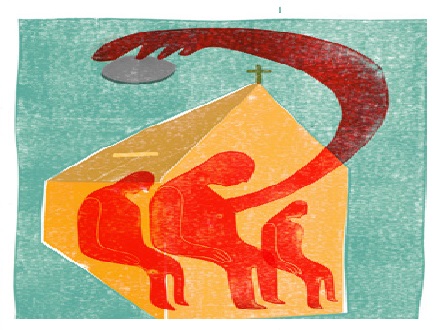
If you are in the habit of calculating ten percent of your paycheck and writing a check to your local church, please stop.

God does not want your tithe. In fact, there's only one thing Jesus asks of you and it's called "Everything".

In the OT, God asked for 10%. In the New Covenant, God gets 100%.

"So therefore, any one of you who does not renounce all that he has cannot be my disciple." - Jesus [Luke 14:33]

The early church called this the doctrine of renunciation. Many modern Christians have reverted back to the Tithe, or "10 Percent" model, but Jesus asks for everything.

Did you know: The Christian Church didn't mandate a tithe until the 7th Century under Charlemagne? Imagine, over 700 years with no tithe? How could that be?

To begin with, offerings in the early church were voluntary and freely given out of love. Most gave more than a tithe (or "tenth"), instead many of them sold their property and shared what they had with those around them who were in need. This offering wasn't given out of compulsion, or due to obedience to a law or a command of the Church. No, it was freely shared out of spontaneous and sincere love.

"Freely you have received; freely give." - Jesus [Matt. 10:8]

Just look at what Tertullian, a second century Christian, tells us about what the early Church did with their offerings:

“Even if there is a treasury of a sort, it is not made up of money paid in initiation fees, as if religion were a matter of contract. Every man once a month brings some modest contribution- or whatever he wishes, and only if he does wish, and if he can; for nobody is compelled; it is a voluntary offering…to feed the poor and to bury them, for boys and girls who lack property and parents, and then for slaves grown old…

“So we, who are united in mind and soul, have no hesitation about sharing property. All is common among us- except our wives. At that point we dissolve our partnership.."


(An excerpt from his “Apology”, taken from “Roman Civilization Sourcebook II: The Empire, p.588)

Notice how they think of this offering:
*People give "modest contribution[s]"
*They give "whatever they wish"
*They give "only if they do wish"
*They give "only if they can"
*"Nobody is compelled" to give
*Offerings are strictly "voluntary", not compulsory 

Look at what they do with the money they receive:
*They "feed the poor"
*They "bury the poor"
*It belongs to "boys and girls who lack property and parents"
*And to "slaves grown old"

Note also that there is no mention of that offering being given to pay pastors or elders among them. Hmm...

Under the New Covenant, Christians are also set free from the idea of worshiping only one day a week, which was commanded under the Old Covenant. Now, under the New Covenant, every day is holy to the Lord. 

Notice that the New Covenant Christians met on only one day of the week - Every day:

"Day by day continuing with one mind in the temple, and breaking bread from house to house, they were taking their meals together with gladness and sincerity of heart, praising God and having favor with all the people. And the Lord was adding to their number day by day those who were being saved." - [Acts 2:46-47]

Under the New Covenant, our worship is a daily undertaking:

"Then he said to them all: “Whoever wants to be my disciple must deny themselves and take up their cross DAILY and follow me." - Jesus [Luke 9:23]

There is also no longer any one Holy Place where everyone must worship [ala the Temple in Jerusalem] because now WE are the living Temple of God, where He dwells by His Spirit.

"Or do you not know that your body is a temple of the Holy Spirit who is in you, whom you have from God, and that you are not your own? For you have been bought with a price: therefore glorify God in your body." [1 Cor. 6;19-20]


This is what we are called to.

Everything we own is God's. We enter the Kingdom by laying everything we own - our very bodies and souls - upon the cross, and then we set out daily to follow the crucified One.

When we see someone in need, we share what we have with them. If the Lord requires something from us, we let go and trust Him for our daily bread.

Because we know that the Lord will never leave us or forsake us, we can freely give - even as we have freely received.

This is what giving is like in the Kingdom. God owns much more than 10 percent. He owns 100 percent.

So, stop tithing, and start sharing freely whatever the Lord asks you to give, out of love and a sincere heart.

"Each one must give as he has decided in his heart, not reluctantly or under compulsion, for God loves a cheerful giver." [2 Cor. 9:7]
-kg

*IMAGE CREDIT: Scott Laumann

Saturday, January 30, 2016

Session 3: Jesus Without Religion [Or Politics]


His Teaching: The Parables of Jesus
Subversive Radio Podcast

Why did Jesus primarily speak in Parables or stories? Why didn't he just speak plainly to everyone? What were these stories all about? Why did these stories resonate so powerfully with so many?
In this podcast we examine the Parables of Jesus.
Click the link to listen in!

Tuesday, January 26, 2016

BETTER THAN


In the book of Hebrews, we see a recurring theme about how everything concerning Jesus is “better than” what has come before.
As it says in Hebrews 7:19:
“…(for the law made nothing perfect), and a better hope is introduced, by which we draw near to God.”
And what is that “better hope”? It’s Jesus. And Jesus has also “become the guarantor of a better covenant” [Heb. 7:22] which is “established on better promises” [Heb. 8:6], and is purified “with better sacrifices.” [Heb. 9:23]
His New Covenant is better than the Old Covenant because it’s unconditional and everlasting. His promises are better because they are all “yes and amen” in Christ. [2 Cor. 1:20] His sacrifices are better because he “desires mercy, not sacrifice” [Matt. 9:13]
Because of this, we who have entered into this New Covenant can more easily “suffer along with those in prison and joyfully accept the confiscation of our property, because [we] know that we [have] better and lasting possessions.” [Heb. 10:34]
Our treasure is in heaven, where our hearts are also, and we seek first His Kingdom and His righteousness rather than material gain or earthly prosperity. [See Matt. 6]
We are also “longing for a better country” [Heb. 11:6] and “an even better resurrection.” [Heb. 11:35]
These are accessible only through Jesus. He enables us to enter the Kingdom of God here and now, not just on the day we die. He guarantees a better resurrection which is eternal and sure.
The Old Covenant, which is now “obsolete” [Heb. 8:13] has been fulfilled because “…Jesus [is] the mediator of a new covenant” and His blood “speaks a better word than the blood of Abel.” [Heb. 12:24]
Abel’s blood cried out to God from the ground for vengeance on his brother Cain who killed him, but the blood of Jesus cries out, “Father, forgive them, for they know not what they do” and that mercy and grace and love are so much better than mere justice.
Yes, in all ways, Jesus is “Better Than” what has come before. Jesus gives us a better hope, a better covenant, better promises, better sacrifices, better possessions, a better country, a better resurrection and a better word – “love” – than anyone or anything else could ever give us.
What could be better than Jesus?
Nothing!
“Because your love is better than life, my lips will glorify you.” [Ps. 63:3]
 -kg
 **
READ THE REST OF THIS SERIES:

BONUS: 
Hebrews in a nutshell: 
Jesus is greater than the prophets (Hebrews 1:1–4). Jesus is greater than the angels (Hebrews 1:5–2:17). Jesus is greater than the priests (Hebrews 2:18–3:2). Jesus is greater than Moses (Hebrews 3:3–4:13). Jesus is greater than Melchizedek (Hebrews 4:14–7:28). Jesus is greater than the Old Covenant (Hebrews 8:1–9:28). Jesus is greater than the Law (Hebrews 10:1–39). We must therefore remain faithful to Jesus (Hebrews 11:1–13:25).

*Thanks to Chuck McKnight for compiling this list.

Monday, January 25, 2016

Session 2: Jesus Without Religion [Or Politics] - His Message


Session 2 of "Jesus Without Religion [Or Politics]" examines the message of Jesus. What was his main point? What did he talk about more than anything else? What is is that Jesus himself says was the reason that he had come?

Listen in to find out. 

Wednesday, January 20, 2016

Session 1: Jesus Without Religion [Or Politics]


Why was Jesus so hard on the religious class and so friendly towards the outcasts and the sinners?

Why is the Christian church so different?

How could Jesus have such an impact on our world with only 3 years of ministry?

Who was Jesus? What was he all about?

Join us for our first session of Jesus Without Religion [Or Politics].

Thursday, January 14, 2016

Early Christians and War by Ron Sider


"The extant historical data make two things perfectly clear. First, as early as 173, there were at least a few Christians in the Roman army. By the late 3rd and early 4th centuries, their numbers were growing substantially, although we lack the data to say how many there were. And second, every single extant pre-Constantinian document by Christian authors that discusses the topic of whether Christians dare ever kill or join the army says no. Shean and Iosif have not produced any evidence to the contrary. As a result, their effort to show that only a few "rigorist" teachers in the pre-Constantinian church were opposed to all killing is based on speculation, not historical data."

 - Ron Sider​

READ THE FULL ARTICLE HERE>

Wednesday, January 13, 2016

The Cyprian Influence


For most of his life, Cyprian was a distinguished and wealthy pagan who lived in a luxurious villa which sprawled across much of the hillside of Carthage where he was born, in the late 3rd century.

Born Thascius Cyprianus, he later took the name Caecilius in memory of the man who introduced him to the Christian faith. Due to his great wealth and influence in the pagan community, Cyprian was ordained as a deacon in the Christian church soon after his baptism and in very short order he was named as Bishop of Carthage, to the protest of many of the faithful in that region.

In spite of the very vocal opposition to Cyprian's fast track to Bishop-hood, which continued to plague him throughout his tenure in that office, his talents as a pagan orator and teacher of rhetoric, along with his great wealth, afforded him great influence within the 3rd century Christian church.

ON THE RUN
Early in his career as Bishop of Carthage, Cyprian was ordered to offer sacrifices to the Emperor or face persecution. He fled to a secluded village and maintained contact with the Church via an appointed contact. As more persecution came upon the members of his church, many others fled as well. However, Cyprian felt very strongly that the Church should not welcome back those Christians who escaped the sword by running away, as he had done. Instead he argued that they should be treated as unbelievers and not be welcomed back into fellowship.

Of course, when he eventually returned from hiding to resume his public office, he wrote a compelling letter explaining why his escape into seclusion was for the strengthening of the Church and that he should, therefore, be allowed to continue as Bishop of Carthage. None of the other Bishops opposed his return to his diocese and he was allowed to continue as if nothing had transpired.

RE-WRITING THE NEW TESTAMENT
Cyprian's greatest influence on the Church was introducing the concepts of priest, temples, rituals, altars and sacrifices to the faith. Until his writings, the Christian church had operated under the New Testament system, largely influenced by Jesus and his Apostles, which held firmly to the notion that the temple, the priesthood and the sacrifice were fulfilled in Christ at His Crucifixion and further that His Followers were also the temple of God, the royal priesthood and that their sacrifice was expressed in the way they lived their lives each day.

Because of Cyprian's skill as an orator and his prominence as a Bishop in Carthage, his pagan ideas of worship were given serious acceptance within the larger Body of Christ. In his writings Cyprian argued for a return to Old Testament Jewish practices which closely mirrored the concepts he had grown up with in a paganized culture.

Sadly, the Christian faith adopted Cyprian's ideas of spiritual covering, the special clergy caste, the importance of ritual and the need for a temple and sacrificial system of worship within one generation, effectively undoing the revolutionary concepts of Church found in the New Testament.

THE CHURCH JESUS BUILT
Inspired by Jesus, the Apostles established a community of believers; a church, based on the revolutionary concept of People-as-Temple and a corporate body which depended not upon a special clergy class, but upon the Holy Spirit Himself.

"...the Counselor, the Holy Spirit, whom the Father will send in my name, will teach you all things and will remind you of everything I have said to you." - Jesus (John 14:26)

Under this radical new concept, the Church was built upon the foundation of Christ as our ultimate priest and sacrice and temple so that each of His followers could also become a temple of the living God, a daily sacrifice and a priest of God.

No one was more vocal about this concept of a living temple of God than Paul the Apostle who wrote prolifically on the subject in nearly every single epistle.

"Don't you know that you yourselves are God's temple and that God's Spirit lives in you?" 1 Cor 3:16

"Do you not know that your body is a temple of the Holy Spirit, who is in you, whom you have received from God? You are not your own." 1 Cor 6:19

"What agreement is there between the temple of God and idols? For we are the temple of the living God. As God has said: "I will live with them and walk among them, and I will be their God, and they will be my people." 2 Cor 6:16

"Consequently, you are no longer foreigners and aliens, but fellow citizens with God's people and members of God's household, built on the foundation of the apostles and prophets, with Christ Jesus himself as the chief cornerstone. In him the whole building is joined together and rises to become a holy temple in the Lord. And in him you too are being built together to become a dwelling in which God lives by his Spirit." - Eph 2:19-22


THE TESTIMONY OF PETER
Peter himself was also very clear on the concept of a living temple made up of people who were also the new priesthood and the daily sacrifice.

In his first epistle he clearly outlined this very concept to those early Christians:

"As you come to him, the living Stone—rejected by men but chosen by God and precious to him— you also, like living stones, are being built into a spiritual house to be a holy priesthood, offering spiritual sacrifices acceptable to God through Jesus Christ." 1 Peter 2:4-5

"But you are a chosen people, a royal priesthood, a holy nation, a people belonging to God, that you may declare the praises of him who called you out of darkness into his wonderful light. Once you were not a people, but now you are the people of God; once you had not received mercy, but now you have received mercy." - 1 Peter 2:9-10


THE CYPRIAN SWITCH
Sadly, in the third century, Cyprian came on the scene and unraveled the tightly woven tapestry spun by Jesus and taught by His Apostles in the New Testament by someone who clearly did not fully understand the genius of this design.

Jesus himself spoke clearly on this subject when asked by the woman at the well about the location and method of proper worship to God. His response was that the temple in Jerusalem was no longer the "special" place to find God. Instead, one could find and worship God wherever they stood, as long as God's Spirit was within him or her.

"Yet a time is coming and has now come when the true worshipers will worship the Father in spirit and truth, for they are the kind of worshipers the Father seeks. God is spirit, and his worshipers must worship in spirit and in truth." - Jesus (in John 4:23-24)

The very fact that the early followers of Jesus did not adopt a system of priesthood, or continue to offer daily sacrifices in a special temple bears witness to the fact that, as evidenced in the Apostolic writings, there was a new temple, priesthood and sacrifice now, and they were it.

Under Christ, the priesthood was now more than just one man overseeing a congregation of several hundred people, the priest was now every single one of those people. It was an exponential multiplication of priests who were also temples of God's Holy Spirit where a daily sacrifice of will and self took place.

"Therefore, I urge you, brothers, in view of God's mercy, to offer your bodies as living sacrifices, holy and pleasing to God—this is your spiritual act of worship.
- Romans 12:1

"Then (Jesus) said to them all: "If anyone would come after me, he must deny himself and take up his cross daily and follow me. For whoever wants to save his life will lose it, but whoever loses his life for me will save it." - Luke 9:23-24


JUST IMAGINE
When Cyprian used his influence to undermine the New Testament and introduced his own ideas about temple, priest and sacrifice, he effectively introduced a virus into the Church which continues to pervade our concepts of worship and church to this very day and hour.

But, what if we could return to the ideas of the New Testament? What if we could learn to live as if God's Holy Spirit lives within every single follower of Jesus? What if we could begin to think of ourselves as priests of God who daily offer themselves as living sacrifices so that Christ could live through us?

What if?

kg

Monday, January 11, 2016

I Won The Lottery!


Why do people dream of winning the lottery?

Obviously, it’s because they dream of a life without worry and stress.

We all want that, don’t we?

Of course, most of us believe that if we had millions – or even billions – of dollars in our bank account, we’d have nothing to worry about. We’d be set for life.

But, as citizens of the Kingdom of God, we already have that assurance from Jesus.

Jesus tells us that our daily bread is secure and He has our today – and our tomorrow – under complete control.

In Matthew 6, Jesus confidently informs His disciples that if they will change their perspective to align with the Kingdom of God, they can enjoy the peaceful, stress-free sort of life they’ve always dreamed of:

"Therefore I tell you, do not worry about your life, what you will eat or drink; or about your body, what you will wear. Is not life more than food, and the body more than clothes? Look at the birds of the air; they do not sow or reap or store away in barns, and yet your heavenly Father feeds them. Are you not much more valuable than they?" [Matthew 6:25-26] 

So, according to Jesus we already have all we need for our life today. Our Heavenly Father knows what we need before we ask and He has already taken care of everything in advance.

Jesus also tells us that we do not need to worry about tomorrow. Why? Because God has everything - absolutely everything - under complete and perfect control:

"So do not worry, saying, ‘What shall we eat?’ or ‘What shall we drink?’ or ‘What shall we wear?’ For the pagans run after all these things, and your heavenly Father knows that you need them. But seek first his kingdom and his righteousness, and all these things will be given to you as well. Therefore do not worry about tomorrow, for tomorrow will worry about itself. Each day has enough trouble of its own." [Matthew 6:31-34 ]

Of course, if God is in control that means that you and I are not.

Here is where most of us really struggle, honestly. 

We want to enjoy a life without worry, but we also want to be in control of our lives. Somehow we think we are in control, but we’re not. Control is an illusion. Only God is in control, and if we rest in the reality of His unending love for us, we can let go of that steering wheel with joy knowing that He knows what He’s doing.

Without trust, our lives are filled with anxiety and strife. But if we can let go of everything and trust that God is good, that He really loves us, and that He really only wants what’s best for us, then trusting Him is the only response that makes sense.

Are you in Christ, Jesus today? Then celebrate your great fortune! You’ve just won the most incredible lottery of all time. You’re rich in all the things that matter – and many more things that don’t.

You have no cause to worry about anything, because God has your whole life in His capable hands. You don’t need to have concern about what tomorrow holds, because you know who holds tomorrow.

The truth is, worldly riches don’t really bring us peace, or comfort, or joy. Just a glance at the news or the tabloids will confirm this for you. No, peace, comfort, joy and life are only found at their source. Jesus is our peace. He is our comfort. He is our joy. He is our life.

You and I are already over our heads, swimming in the deepest depths of an ocean of blessings found only in the unsearchable riches of Christ. There is no greater treasure than that.

“I have learned to be content whatever the circumstances. I know what it is to be in need, and I know what it is to have plenty. I have learned the secret of being content in any and every situation, whether well fed or hungry, whether living in plenty or in want. I can do all this through him who gives me strength." [Philippians 4:11-13 ]

Some people are so poor, all they have is money. You and I have been adopted as sons and daughters into the family of God, who created the Universe and owns all things. This same God has invited us to call him "Abba" or "Poppa" and He assures us that it is His good pleasure to give to us the Kingdom. 

Celebrate!

-kg


Friday, January 08, 2016

NOT A RESOLUTION


I'm not someone who makes New Year's Resolutions to lose weight, or eat healthy, or what have you. It's my understanding that those who do almost never follow through with their plans anyway. So, I've never felt the need to follow that trend.

But the other day my dear brother in Christ, Dan Notti, asked me to help him keep a few promises he's made to himself this year. After reading his list I was inspired to create one of my own.

Based on what I was already hearing the Lord whisper to me over the last several weeks, I wrote down these goals:

  • To abide in Christ more and more.
  • To let love be my dominant response to others.
  • To spend more quality time with my wife, Wendy.
  • To spiritually mentor my sons.
  • To write at least one book and possibly a second book before year's end.

The calling to abide in Christ more and more stems from a simple realization that I need more of Jesus in my life. Everything else I might desire flows out of this.

If I hope to love more in the year ahead, it will only happen to the degree that I allow Jesus to live and breathe in me on a daily basis.

My attention to my wife's needs, and to my son's spiritual development will only emerge if I am connected to Christ and abiding in Him.

Writing my books might not seem to be necessarily dependent upon my experience of Jesus, but I would certainly prefer to be led by His Spirit as I write these books so that what He wants to be communicated is what I publish.

So, please don't call this a New Year's Resolution. It's nothing of the sort. It's simply my decision to lean more into Jesus today and to continually do so until I see Him face to face.

-kg

Thursday, January 07, 2016

The New Jerusalem Has Already Come Down


“Then I saw a new heaven and a new earth, for the first heaven and the first earth had passed away, and the sea was no more. And I saw the holy city, new Jerusalem, coming down out of heaven from God, prepared as a bride adorned for her husband.” [Rev. 21:1-3]


John kicks off this chapter by declaring that the New Jerusalem – which is the Bride of Christ – has come down from heaven in fulfillment of the promise that “The dwelling place of God” would be “with man” and that God “will dwell with them, and they will be his people, and God himself will be with them as their God.” [Rev. 21:3]

I know that many are tempted to read this passage – and certainly this entire epistle of John – as if it were entirely futuristic. But there are some problems with that, I think. Especially when it comes to the New Covenant, which the prophet Jeremiah foreshadowed and Jesus proclaimed as being inaugurated on the night before his crucifixion at the final Passover supper with his disciples.

“This cup is the New Covenant in my blood,” Jesus said. That New Covenant is simply this:

“For this is the covenant that I will make with the house of Israel after those days, declares the Lord: I will put my laws into their minds, and write them on their hearts, and I will be their God, and they shall be my people.” [Hebrews 8:10]

Keep in mind, the old city of Jerusalem which existed at the time of Christ, and before John wrote Revelation, was destroyed in AD 70. Its destruction was the “End of the Age” and when it was destroyed, so was the Old Covenant system.

Out of the ashes of that temporal city arose the new spiritual Jerusalem, and with the destruction of that Old Covenant Temple there was constructed a new, living Temple of the New Covenant, which is the Church.

Later in the chapter, John says:

“Then came one of the seven angels who…spoke to me, saying, ‘Come, I will show you the Bride, the wife of the Lamb.” And he carried me away in the Spirit to a great high mountain and showed me the holy city Jerusalem coming down out of heaven from God, having the glory of God…” [Rev. 21:9-11]

The Church is the Bride of Christ, and as John tells us in Revelation, the New Jerusalem has already come down from Heaven [by the power of the indwelling Holy Spirit] and now grows to cover the entire earth.

Then John goes on to say:

“And I saw no temple in the city, for its temple is the Lord God the Almighty and the Lamb. And they city has no need of sun or moon to shine on it, for the glory of God gives it light, and its lamp is the Lamb. By its light will the nations walk, and the kings of the earth will bring their glory into it, and her gates will never be shut by day – and there will be no night there. They will bring into it the glory and the honor of the nations. But nothing unclean will ever enter it, nor anyone who does what is detestable or false, but only those who are written in the Lamb’s book of life.” [Rev. 21:22-27]

Within the Church – or the New Jerusalem – there is no temple other than Jesus Himself. He abides within us, and we abide within Him. We are the living Temple of the Holy Spirit where Christ lives, and Christ is the living Temple where all of us “live and move and have our being.”

Christ is our light, and because of this, we are the light of the world.

"You are the light of the world--like a city on a hilltop that cannot be hidden.” – Jesus [Matt. 5:14]

The Bride of Christ is here now. We are the Incarnation of Christ in the world now. He is our Head, and we are His Body.

“And I heard a loud voice from the throne saying, “Behold, the dwelling place of God is with man. He will dwell with them, and they will be his people, and God himself will be with them as their God.” [Rev. 21:3]

Has God not made His dwelling among men? Isn't this what Jesus, and Stephen, and the other Apostles proclaimed over and over again?

The New Jerusalem has already been planted like a seed on the earth. Now it continues to grow daily, and the Lord is adding to Her number daily, as His Kingdom advances and His rule and reign expands.

“For to us a child is born, to us a son is given; and the government shall be upon his shoulder, and his name shall be called Wonderful Counselor, Mighty God, Everlasting Father, Prince of Peace. Of the increase of his government and of peace there will be no end, on the throne of David and over his kingdom, to establish it and to uphold it with justice and with righteousness from this time forth and forevermore. The zeal of the Lord of hosts will do this.” [Isaiah 9:6-7]


[Image Credit: Moebius]

Wednesday, January 06, 2016

INSTANT REPLAY


I love when I see something brand new in a passage of Scripture that I've never noticed before.

Recently, while reading the final chapter of the Gospel of John, I saw an incredible parallel of the life of Peter playing out before me.

First, John does Peter a great honor by closing out his Gospel with this touching portrait of Jesus' tender heart towards the formerly-boisterous disciple in his hour of humiliation.

Peter decides to go fishing. A handful of other disciples go with him. They fish all night and catch nothing, much as they had done on the day that Jesus called Peter to become a follower three years earlier.

Jesus stands on the shore, but they don't realize it's him yet. He calls out and asks if they caught anything and when they say, "No", he tells them to throw their nets on the other side of the boat and they haul in a huge catch of fish - again, just as they had done on that day when Jesus called Peter to "Follow Me!"

That's when they realize it's Jesus. Peter then steps out of the boat. Just like he did that night in the storm when Jesus called him out on the waves and he sunk like a stone after looking away from Jesus.

When Peter gets to shore, Jesus already has fish, and bread, cooking on a fire. "Go and bring some of the fish you just caught," Jesus tells him. Much as Jesus did when he fed the multitudes saying, "bring your loaves and fishes to me" right before multiplying their small portions to feed not only the thousands around them, but with leftover to feed the rest of the disciples, too.

Once everyone else arrives from the boat and they sit around the fire, Jesus takes bread, and fish, and begins breaking them into pieces and passing them around to everyone. Just like he did that day when he fed the thousands, and just like he did that night in the upper room saying, "Take, eat, this is my body, broken for you."

Surely they noticed the repeating of these actions. Certainly, Peter did.

Around the fire, Jesus asks, "Do you Agape [Perfectly love] me, more than all the rest?", much as the girl around the fire asked Peter, "Weren't you with this Jesus of Nazareth?" that night when Peter betrayed him.

Peter is only able to answer, "I Phileo [Brotherly love] you."

Jesus says, "Feed my lambs", much in the same way as he had told Peter and the other disciples when they wanted to send the multitudes away, "No, you give them something to eat."

How could Peter feed all of Jesus' followers? He had only just pulled in a catch of 153 fish, which was a lot for his family, but not enough for all of those who were following Jesus. However, Peter certainly realized that the 3 loaves and two fish were more than enough for thousands that day, and his 153 fish would be more than enough for the hundreds of thousands who would soon gather around Jerusalem and beyond, because Jesus would make it enough, as He always did.

A second time Jesus asks, "Do you Agape me?" and Peter says, "I Phileo you, Lord" and Jesus again responds, "Feed my sheep."

The third question grieves Peter, because it pointed to his three denials of Christ that night, but here Jesus changes his question: "Do you Phileo me, Peter?" and then Peter says, "You know all things, Lord. You know that I love you like a brother."

"Then feed my sheep," Jesus says.

And then he adds, "Follow me," which is exactly what he said to Peter that first day when he called him to become a disciple after the miraculous catch of fish nearly sank his father's boat.

There, in the space of about an hour, Jesus put Peter through an instant replay of their last 3 years together; from Peter's first calling, to the miraculous feeding of the multitudes, through that night before the crucifixion and the last Passover supper they ate together, to Peter's embarrassing denial of Jesus a few hours later around the fire.

Like all of us, Peter got distracted by what another disciple was doing. "What about him?" Peter asks, pointing to John. "What is that to you?" Jesus responds. "Follow me!"

And with that Peter's spiritual resurrection was complete. He remembered who he used to be. He remembered who was in Christ, now that Jesus had restored their friendship. He understood that his primary focus was his own obedience to Jesus' commands to follow, and to feed His sheep, without worrying about what anyone else was doing, or not doing.

I love this chapter. I'm so grateful to the Apostle John for including it there at the end of his Gospel, to remind us that Jesus understands our weakness, and that if the best we can say is "I love you like a brother", it's a good enough place to begin our journey with Him.