Showing posts with label old covenant. Show all posts

Monday, January 30, 2017

5 MINUTE VIDEO: Flat Bible vs Jesus-Centric Perspectives?


Take 5 minutes and listen as Keith explains the difference between a "Flat Bible" perspective and a "Jesus-Centric" perspective, and how these two views can make a difference between entanglement and being untangled from politics and the world.


Buy your copy of "Jesus Untangled:Crucifying Your Politics To Pledge Allegiance To The Lamb" at Amazon:


Want to learn more about the Old Testament vs the New Testament?


Peace,
-kg

Wednesday, August 17, 2016

10 REASONS YOU SHOULD NOT TITHE


Here are 10 very good reasons to stop tithing your 10% every week.


  1. The command to tithe was given only to the Jewish people. It was intended to provide for the upkeep of the Temple in Jerusalem and to support the Priesthood who owned no land and did not work to support themselves.
  2. The Temple in Jerusalem is gone now and has been for over 2,000 years, since its destruction by the Romans in AD 70.
  3. There is no longer any need to support a priesthood made up of people who do not own land or work for a living.
  4. The Old Covenant is now obsolete according to Hebrews 8:13. Therefore no one needs to keep those laws anymore.
  5. If you are in Christ then you are now the Temple of God where He has made His home. [See 1 Cor. 6:19-20]
  6. Those who abide in Christ are automatically ordained into the Priesthood of All Believers. [See 1 Peter 2:4-5 and 2:9-10]
  7. The daily sacrifice that was once offered in the Jewish Temple is now replaced by the living, daily sacrifice of every member of Christ's Body. [See Romans 12:1]
  8. The New Testament scriptures do not command anyone to tithe and the Church didn't formally institute the tithe until 777 AD under Charlemagne. For over 700 years no one who followed Christ tithed anything to the church.
  9. The New Covenant standard is not 10%, but 100%. God owns everything, and we are commanded to surrender everything to Christ. [See Luke 9:23 and Mark 12:17 ]
  10. The early Christians only practiced a freewill offering, not a mandatory ten percent obligation. Just look at what Tertullian, a second century Christian, tells us about what the early Church did with their offerings:  
           “Even if there is a treasury of a sort, it is not made up of money paid in initiation fees, as if                   religion were a matter of contract. Every man once a month brings some modest                                   contribution- or whatever he wishes, and only if he does wish, and if he can; for 
            nobody is compelled; it is a voluntary offering…to feed the poor and to bury them, for boys                 and girls who lack property and parents, and then for slaves grown old…So we, who are                     united in mind and soul, have no hesitation about sharing property. All is common 
            among us- except our wives. At that point we dissolve our partnership.."

IN SUMMARY: 
No Christian today should continue to follow the Old Covenant mandate given to pre-Christian Jews to surrender ten percent of their income to their religious leaders. 

Now that everyone who is in Christ has been named the Temple of God, and has become the daily, living sacrifice, and has been ordained into the Priesthood of God, there is no longer any need to pay tithes to upkeep a building or to support a separate group or class of religious leaders.

Under the New Covenant, God owns 100%. We are called to surrender all that we have to Christ and to follow Him with our whole life. Under this New Covenant we do not relegate worship to one day a week, but we now seek and serve and worship Him every single day of our lives. 

So, stop holding back from God. Give 100 percent of your time, your money, your talent, and your life to Him.

Stop following rules and begin to follow the voice of the Spirit of God that lives within you.

Give freely, because you have freely received. [Matt. 10:8]

"Each of you should give what you have decided in your heart to give,not reluctantly or under compulsion, for God loves a cheerful giver." [2 Cor. 9:7]

-kg

FOR FURTHER READING

Friday, May 06, 2016

Jesus and Torah


Does Jesus break the Torah? Does He encourage others to do so? Here, in this guest post, my friend Chuck McKnight makes some very insightful observations which I believe are on the right track.

**
Jesus and Torah
Guest post by Chuck McKnight

I made this list a while ago of just a few examples where Jesus deliberately breaks Torah. Take it or leave it.

According to Torah, the Israelites were commanded by Yahweh to swear in his name.

"You shall fear the Lord your God and serve Him, and shall take oaths in His name." - Deuteronomy 6:13

Jesus not only contradicted this command, he said that it came from the evil one, which certainly means that it did not come from Yahweh 

"But let your ‘Yes’ be ‘Yes,’ and your ‘No,’ ‘No.’ For whatever is more than these is from the evil one." - Matthew 5:37

According to Torah, "an eye for an eye and a tooth for a tooth" was an absolute mandate. The Israelites were commanded to "show no mercy" in carrying it out:

"Show no pity: life shall be for life, eye for eye, tooth for tooth, hand for hand, foot for foot." - Deuteronomy 19:21

But Jesus directly contradicted this mandate, commanding his followers not to follow Torah's instructions:

“You have heard that it was said, ‘Eye for eye, and tooth for tooth.’But I tell you, do not resist an evil person. If anyone slaps you on the right cheek, turn to them the other cheek also." - Matthew 5:38–39

According to Torah, adultery was to be punished with death. No exceptions were given.

‘If a man commits adultery with another man’s wife—with the wife of his neighbor—both the adulterer and the adulteress are to be put to death." - Leviticus 20:10


But Jesus broke Torah in order to show mercy to the woman caught in adultery. [See John 8]

According to Torah, no work was to be done on the Sabbath.

"But the seventh day is a sabbath to the Lord your God. On it you shall not do any work, neither you, nor your son or daughter, nor your male or female servant, nor your ox, your donkey or any of your animals, nor any foreigner residing in your towns, so that your male and female servants may rest, as you do." - Deuteronomy 5:14

But Jesus flaunted his disregard for this particular command on many occasions. Let's look at one of the most direct violations:

When Jesus healed the man by the pool of Bethesda, he not only did so on the Sabbath, but he specifically instructed the man to break the Sabbath with him by carrying his mat.

"Then Jesus said to him, “Get up! Pick up your mat and walk.” At once the man was cured; he picked up his mat and walked. The day on which this took place was a Sabbath" - John 5:8–9


This was nothing less than a deliberate contradiction of Jeremiah 17:21–22, which states that Yahweh specified not to carry any burden on the Sabbath. This command wasn't one of the traditions that had been built up as a hedge around the law; it came straight from Scripture.

"This is what the Lord says: Be careful not to carry a load on the Sabbath day or bring it through the gates of Jerusalem. Do not bring a load out of your houses or do any work on the Sabbath, but keep the Sabbath day holy, as I commanded your ancestors." - Jeremiah 17:21-22

If Jesus was merely concerned with healing the man, he would have simply done so, but he went out of his way to go against the law in the process, [by asking the man to take up his mat and carry it] and that action was what specifically raised the ire of the Jews:

"...and so the Jewish leaders said to the man who had been healed, “It is the Sabbath; the law forbids you to carry your mat.” - John 5:10


**
So, what are we to make of this? I [Keith] have a few thoughts:

First, Jesus himself was the first one to point out the differences between the Old and the New Covenant realities: "You've heard it said....[quoting Moses and the Old Covenant]...but I say to you...[speaking a new way of living under the New Covenant]."

Second, the New Testament writers document these two realities and wrestle sometimes with the ways that the New replaces and modifies the Old in the book of Acts, and in Galatians and Romans, for example.

Third, Jesus is the clearest picture we have of who the Father is, and what the Father is like. The prophets were men like us, but Jesus was, and is, the Word of God made flesh. He is God the Son. So whenever there are apparent contradictions, we take Jesus and apply what He says, not what those ancient prophets said through a veil that is only removed by Christ. 

Finally, Christians are never instructed to keep the Torah or the Law. So it doesn't really matter if Jesus and the Torah are in conflict. We follow Jesus, not the Torah. Christianity is not Judaism with a cross on top. It's based on Jesus and who He is and what He commanded us to do. 

The Old Covenant is "obsolete". [Heb. 8:13]
It is "fading away and vanishing". [2 Cor. 3:7-11]
We should "get rid of it" [Gal.4:30]
Jesus is "the end of the Law" [Rom.10:4]

I'm very thankful to Chuck McKnight for taking the time to identify the specific ways in which Jesus opposed the Torah and corrected it for us.

We are no longer under the Old Covenant. We are gloriously alive in the New Covenant reality that the prophets longed to see. 

God Himself, and Jesus, His Son, has made a home within us. We are now called His children. We are His beloved. 

-kg

Follow Chuck McKnight at his blog: Hippie Heretic

FOR FURTHER READING:
QUESTIONS ABOUT THE OLD AND NEW COVENANT


Tuesday, February 02, 2016

PLEASE STOP TITHING


If you are in the habit of calculating ten percent of your paycheck and writing a check to your local church, please stop.

God does not want your tithe. In fact, there's only one thing Jesus asks of you and it's called "Everything".

In the OT, God asked for 10%. In the New Covenant, God gets 100%.

"So therefore, any one of you who does not renounce all that he has cannot be my disciple." - Jesus [Luke 14:33]

The early church called this the doctrine of renunciation. Many modern Christians have reverted back to the Tithe, or "10 Percent" model, but Jesus asks for everything.

Did you know: The Christian Church didn't mandate a tithe until the 7th Century under Charlemagne? Imagine, over 700 years with no tithe? How could that be?

To begin with, offerings in the early church were voluntary and freely given out of love. Most gave more than a tithe (or "tenth"), instead many of them sold their property and shared what they had with those around them who were in need. This offering wasn't given out of compulsion, or due to obedience to a law or a command of the Church. No, it was freely shared out of spontaneous and sincere love.

"Freely you have received; freely give." - Jesus [Matt. 10:8]

Just look at what Tertullian, a second century Christian, tells us about what the early Church did with their offerings:

“Even if there is a treasury of a sort, it is not made up of money paid in initiation fees, as if religion were a matter of contract. Every man once a month brings some modest contribution- or whatever he wishes, and only if he does wish, and if he can; for nobody is compelled; it is a voluntary offering…to feed the poor and to bury them, for boys and girls who lack property and parents, and then for slaves grown old…

“So we, who are united in mind and soul, have no hesitation about sharing property. All is common among us- except our wives. At that point we dissolve our partnership.."


(An excerpt from his “Apology”, taken from “Roman Civilization Sourcebook II: The Empire, p.588)

Notice how they think of this offering:
*People give "modest contribution[s]"
*They give "whatever they wish"
*They give "only if they do wish"
*They give "only if they can"
*"Nobody is compelled" to give
*Offerings are strictly "voluntary", not compulsory 

Look at what they do with the money they receive:
*They "feed the poor"
*They "bury the poor"
*It belongs to "boys and girls who lack property and parents"
*And to "slaves grown old"

Note also that there is no mention of that offering being given to pay pastors or elders among them. Hmm...

Under the New Covenant, Christians are also set free from the idea of worshiping only one day a week, which was commanded under the Old Covenant. Now, under the New Covenant, every day is holy to the Lord. 

Notice that the New Covenant Christians met on only one day of the week - Every day:

"Day by day continuing with one mind in the temple, and breaking bread from house to house, they were taking their meals together with gladness and sincerity of heart, praising God and having favor with all the people. And the Lord was adding to their number day by day those who were being saved." - [Acts 2:46-47]

Under the New Covenant, our worship is a daily undertaking:

"Then he said to them all: “Whoever wants to be my disciple must deny themselves and take up their cross DAILY and follow me." - Jesus [Luke 9:23]

There is also no longer any one Holy Place where everyone must worship [ala the Temple in Jerusalem] because now WE are the living Temple of God, where He dwells by His Spirit.

"Or do you not know that your body is a temple of the Holy Spirit who is in you, whom you have from God, and that you are not your own? For you have been bought with a price: therefore glorify God in your body." [1 Cor. 6;19-20]


This is what we are called to.

Everything we own is God's. We enter the Kingdom by laying everything we own - our very bodies and souls - upon the cross, and then we set out daily to follow the crucified One.

When we see someone in need, we share what we have with them. If the Lord requires something from us, we let go and trust Him for our daily bread.

Because we know that the Lord will never leave us or forsake us, we can freely give - even as we have freely received.

This is what giving is like in the Kingdom. God owns much more than 10 percent. He owns 100 percent.

So, stop tithing, and start sharing freely whatever the Lord asks you to give, out of love and a sincere heart.

"Each one must give as he has decided in his heart, not reluctantly or under compulsion, for God loves a cheerful giver." [2 Cor. 9:7]
-kg

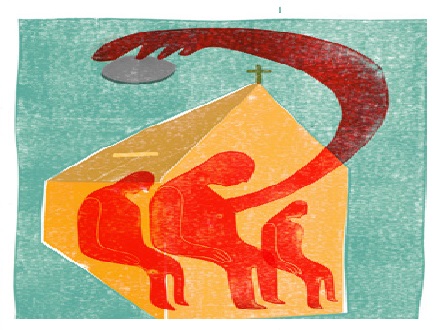
*IMAGE CREDIT: Scott Laumann

Tuesday, March 10, 2015

New Is Good


Tired of the “same old song and dance”? Who isn’t? Luckily, Jesus has fulfilled and abolished the Old and replaced it with the New.

It all starts with the New Covenant that Jesus made with those who place their trust in Him:

“This cup that is poured out for you is the new covenant in my blood.” – (Luke 22:20)

Once we drink from that cup, He gets right to work making us new as well:

“Therefore, if anyone is in Christ, he is a new creation. The old has passed away; behold, the new has come.” – (2 Cor. 5:17)

Once we’ve been made new Jesus pours His “new wine” into us:

“Neither is new wine put into old wineskins. If it is, the skins burst and the wine is spilled and the skins are destroyed. But new wine is put into fresh wineskins, and so both are preserved.” – (Matt. 9:17)

Filled with the “new wine” of His Holy Spirit, Jesus empowers us to follow His “new commandment”:

“A new commandment I give to you, that you love one another: just as I have loved you, you also are to love one another.” – (John 13:34)

Next, Jesus opens the door wide open for us to enter into glorious fellowship with Himself and His Father:

“…. we have confidence to enter the holy places by the blood of Jesus, by the new and living way that he opened for us through the curtain, that is, through his flesh…” – (Heb. 10:19-20)

Jesus even abolished the Old Law of Commandments in order to make both Jews and Non-Jews into “one new man” so that those who are in Him are united as His Chosen Ones:

“ For he himself is our peace, who has made us both one and has broken down in his flesh the dividing wall of hostility by abolishing the law of commandments expressed in ordinances, that he might create in himself one new man in place of the two, so making peace…” - (Eph. 2:15)


To those who continue to abide in Him, Jesus promises to keep on making things new, even giving us a new name to match our new nature and identity in Himself:

“To the one who conquers I will give some of the hidden manna, and I will give him a white stone, with a new name written on the stone that no one knows except the one who receives it.’” – (Rev. 2:17)

What’s more, from now until the end of time, Jesus is continually, daily, making all things new again so that, eventually, everything old is redeemed and under His final, ultimate authority:

“And he who was seated on the throne said, “Behold, I am making all things new.” – (Rev. 21:5)

Now, that’s Good New!

-kg


 **
NOTE: For more about the differences between the Old and New Covenant, read "Questions About The Old and The New Covenants"

Wednesday, April 30, 2014

Out With The Old. In With The New.


Which has more relevance for you:The 10 Commandments or The Sermon On The Mount?

Which one trumps the other: Moses or Jesus?

Does the question confuse you? Maybe so. “Aren’t they both equal in weight and value?” you might ask.

But think of it this way: Should we allow the Old Testament scriptures to inform our understanding of the New? Or is it the other way around?

American Christians have been lulled into an Old Testament form of Christianity. We’ve started to gravitate to a more Moses-centric form of Christianity rather than a purely Jesus-form.

If we’re followers of Christ, for example, why wouldn’t we want the words of Jesus on our buildings in public places rather than the Ten Commandments?

Imagine “Blessed are the poor for theirs is the Kingdom of God” posted in your Courthouse? Or “Love God with all your heart, soul, mind and strength. And…love your neighbor as yourself” displayed in our Town Squares? Wouldn’t that be more radical and “Christ-like” than a list of “Thou Shalt Not’s”?

But back to our previous question: Do we interpret the New Testament in view of the Old Testament? Or do we use the New Testament – and the teachings of Jesus and the Apostles – to help us understand the Old Covenant scriptures?

According to Paul, the Gospel is a mystery to everyone who came before Jesus. In fact, he says it four different times:

“We do, however, speak a message of wisdom among the mature, but not the wisdom of this age or of the rulers of this age, who are coming to nothing. No, we declare God’s wisdom, a mystery that has been hidden and that God destined for our glory before time began.” (1 Cor. 2:6-7)


“In reading this, then, you will be able to understand my insight into the mystery of Christ, which was not made known to people in other generations as it has now been revealed by the Spirit to God’s holy apostles and prophets.” (Eph. 3:4-5)


“Now to him who is able to establish you in accordance with my gospel, the message I proclaim about Jesus Christ, in keeping with the revelation of the mystery hidden for long ages past, but now revealed and made known through the prophetic writings by the command of the eternal God, so that all the Gentiles might come to the obedience that comes from faith.” (Rom. 16:25-26)


“I have become its servant by the commission God gave me to present to you the word of God in its fullness— the mystery that has been kept hidden for ages and generations, but is now disclosed to the Lord’s people.” (Col. 1:25-26)

The Apostle Peter says it this way:

“Concerning this salvation, the prophets, who spoke of the grace that was to come to you, searched intently and with the greatest care, trying to find out the time and circumstances to which the Spirit of Christ in them was pointing when he predicted the sufferings of the Messiah and the glories that would follow. It was revealed to them that they were not serving themselves but you, when they spoke of the things that have now been told you by those who have preached the gospel to you by the Holy Spirit sent from heaven. Even angels long to look into these things.” (1 Peter 1:10-12)

This is why Jesus, after he had risen from the dead, had to “open (the) understanding” of the disciples so “that they might comprehend the scriptures.” (Luke 24:44-45)

It’s also why Paul says, “But their minds were made dull, for to this day the same veil remains when the old covenant is read. It has not been removed, because only in Christ is it taken away.” (2 Corinthians 3:13-15)

In short, Jesus illuminates the Old Covenant scriptures. He alone “removes the veil” so that we can understand when the old covenant is read. The Apostles, under the power of the Holy Spirit, were empowered to reveal the true meanings and mysteries for us.

So, the teachings of Jesus from the Sermon on the Mount are more authoritative for us than the teachings of Moses. Even Moses acknowledged this in Deuteronomy 18:15, and Peter reminded everyone of this in one of his earliest messages to the people, saying:

“For Moses said, ‘The Lord your God will raise up for you a prophet like me from among your own people; you must listen to everything he tells you. Anyone who does not listen to him will be completely cut off from their people.’” (Acts 3:22-23)

And Stephen also reminded everyone of this same fact in Acts 7:37 just before they stoned him to death.

So, Jesus – not Moses, not Jewish Rabbis, not the traditions of men – and His Apostles to whom He has revealed this mystery, are the ones we should be listening to.

Jesus is greater than any human prophet. He is the Son of God, and God the Son. He is Emmanuel, “God With Us” and He is the Word of God made flesh to dwell among us.

Let us remember the words of our Heavenly Father on the mount of transfiguration - after He had removed Moses and Elijah from their presence – when He said: “This is my beloved son. Listen to him!” (Matt. 17:5)

Yes. Let’s.

-kg

Friday, May 31, 2013

PRIESTLY FOOD


Reading from Hebrews the other day and noticed an interesting correlation between the Levite priesthood under the Old Covenant and the New Testament priesthood of believers.

Under the Old Covenant, the Levitical priests were allowed to eat what was offered on the altar. Whether that was a sacrificed lamb or bull, after the animal was sacrificed and burnt on the altar, they were given the leftover meat to feed themselves and their families. In fact, it was one of the various ways that the other tribes of Israel provided for the well-being of those Levites who worked in the temple and had no land or property of their own.

Paul references this principle here:

 “Don't you know that those who serve in the temple get their food from the temple, and that those who serve at the altar share in what is offered on the altar?” (1 Cor. 9:13)

Now, what struck me was how Jesus gave us His body to eat and stressed that if we did not eat it (receive His sacrifice) that we would not have life in us.

“Jesus said to them, “Very truly I tell you, unless you eat the flesh of the Son of Man and drink his blood, you have no life in you. Whoever eats my flesh and drinks my blood has eternal life, and I will raise them up at the last day. For my flesh is real food and my blood is real drink. Whoever eats my flesh and drinks my blood remains in me, and I in them.” (John 6:53-56)

Not only is this meant to illustrate the need for us to have the life of Christ within us, I believe it’s also meant to correspond to the sacrificial lamb which is eaten only by the priesthood.

So, because we who are in Christ are now members of the new Priesthood of Believers, we are privileged to eat of the One true sacrifice of the Lamb of God who takes away the sins of the world.
 
No one else is allowed to eat of this sacrificial food from off of God’s altar, only those who are of the true priesthood.
 
Because we are the new priesthood of a new covenant, we are allowed to eat the body of the sacrificial lamb that was laid on the altar in sacrifice for our sins.
 
-kg

Friday, May 25, 2012

NOT ONE JOT OR TITTLE?


Jesus says, “For truly I tell you, until heaven and earth disappear, not the smallest letter, not the least stroke of a pen, will by any means disappear from the Law until everything is accomplished.” (Matthew 5:18)

At the beginning of his Sermon on the Mount, Jesus begins by establishing that he has not come to abolish the Law but to fulfill it. In the King James version of this same verse the phrase “one jot or one tittle” shall pass from the Law.

But, what did Jesus mean to communicate in this sentence? Did he mean, as some suggest, that the Old Covenant Law should be observed until the return of Christ? Or did Jesus intend to say something different?

We must first look at the context in which Jesus spoke these words. At the Sermon on the Mount, Jesus is speaking primarily to his disciples about the Kingdom of God that he has come to inaugurate. His Beatitudes establish a new set of values that stand in stark contrast to the values of this World. He lays out a set of expectations for his followers to go above and beyond the Old Covenant laws to embody a more radical expression of God’s love to the World.

So, when Jesus pauses at the beginning of his Sermon to say, “Do not think that I have come to abolish the Law or the Prophets; I have not come to abolish them but to fulfill them”(v. 17), he is preparing them to hear what is about to come next. Namely statements that appear to contradict the Old Covenant Laws but in fact take them to another level. Statements like:

“You have heard that it was said to the people long ago, ‘You shall not murder, and anyone who murders will be subject to judgment.’ But I tell you that anyone who is angry with a brother or sister will be subject to judgment.” (v.21-22)

Additionally, we have to take into account the qualifier that Jesus adds at the end of his “jot and tittle” statement when he says “until everything is accomplished.”

Let’s first ask ourselves, “Has anything from the Old Covenant Law ceased or passed away?”

The answer, of course, is “Yes.” We don’t observe animal sacrifice any more. We don’t observe the Sabbath anymore. We don’t support a Levitical priesthood with our tithes any longer. We don’t keep Jewish festivals or feasts or observe holy days any longer. We don’t insist on circumcising male children on the 8th day. These are parts of the Law that have since passed away.

So, what’s up? Is Jesus wrong? Or maybe the Law and the Prophets have been fulfilled? Let’s see what Paul says about this:

“Therefore do not let anyone judge you by what you eat or drink, or with regard to a religious festival, a New Moon celebration or a Sabbath day. These are a shadow of the things that were to come; the reality, however, is found in Christ.” (Colossians 2:16-17)

The shadows were summed up in the Old Covenant dietary commands to avoid pork and shell fish, and to observe religious festivals, including the Sabbath day. But these all pointed us to the Messiah – the reality – who has already now come. Because he has come and because Jesus has fulfilled these shadows of the Old Covenant they are now obsolete and we are under a New Covenant. As it says it Hebrews:

“By calling this covenant “new,” he has made the first one obsolete; and what is obsolete and outdated will soon disappear.” (Hebrews 8:13)

“But in fact the ministry Jesus has received is as superior to theirs as the covenant of which he is mediator is superior to the old one, since the new covenant is established on better promises. For if there had been nothing wrong with that first covenant, no place would have been sought for another.” (Hebrews 8:6-7)

“The law is only a shadow of the good things that are coming—not the realities themselves.” (Hebrews 10:1)

So, while Jesus does affirm to his disciples that the Old Covenant Law and the word of the Prophets will not pass away, he clarifies that they will stand until they are fulfilled. Jesus fulfilled them. Now they are passing away.

This means we are no longer under the Old Covenant. I know that for some of you this isn’t big news. But for many, many people this is a very strange concept. I’m constantly running into people (mostly online) who continue to return to the Old Covenant scriptures to make a point about how a Christian should behave, or to quote Old Testament prophets to settle an argument about how we should interpret Jesus. This is bass-ackwards (as my father would say). We should never interpret Jesus or Paul or any of the New Covenant scriptures through the lens of the Old. Instead, we should always take the words of Jesus as authoritative and interpret the Old Covenant in light of the new revelation we have received through Christ.

To do any less is to put ourselves back into bondage to the Law. As Paul says, this is foolish:

“Such a person also goes into great detail about what they have seen; they are puffed up with idle notions by their unspiritual mind. They have lost connection with the head, from whom the whole body, supported and held together by its ligaments and sinews, grows as God causes it to grow.” (Colossians 2:18-19)

“These rules, which have to do with things that are all destined to perish with use, are based on merely human commands and teachings. Such regulations indeed have an appearance of wisdom, with their self-imposed worship, their false humility and their harsh treatment of the body, but they lack any value in restraining sensual indulgence.” (Colossians 2:22-23)

Now that Jesus has come and now that he has fulfilled all the Law and the Prophets we are truly set free. God has written His laws upon our hearts. He has called us to be His people and for us to call Him our “Abba”.

We are no longer bound by those Old Covenant regulations and laws. We are children of God. We are co-heirs with Christ. We are Ambassadors of the Kingdom of God.

-kg

Tuesday, July 06, 2010

RECONCILING THE GOD OF THE OLD TESTAMENT WITH THE GOD OF THE NEW

Has anyone ever pointed out to you the apparent difference between the way God behaved in the Old Testament and the way Jesus reveals Him in the Gospels? Perhaps you yourself have struggled with this apparent contradiction of character? Is there a logical explanation for why God seems to be so bloodthirsty and vengeful in the Old Testament scriptures, and yet so loving and gentle in the New Testament?

Well, this debate is as old as Christianity itself. In fact, the very first person to point out this difference was Jesus himself. In the Gospel of Matthew, chapter 5, Jesus quotes the Old Covenant and then makes a new proclamation that demonstrates the differences between the two.

First, he points out the differences in the Old Covenant command “Thou Shalt Not Kill” found in the Law of Moses and provides a radical new command under the New Covenant:

"You have heard that it was said to the people long ago, 'Do not murder, and anyone who murders will be subject to judgment.' But I tell you that anyone who is angry with his brother will be subject to judgment” – Matt 5:22-23

Here at the start of his sermon on the mount, Jesus lays out for everyone a new covenant perspective which permeates the Good News of the Kingdom he has come to proclaim.

In the past, God operated under the Old Covenant rule which was expressed through the Law of Moses, or the Ten Commandments. Now, according to Jesus, things will be different. As we enter the Kingdom of God, we can now expect something new. Instead of "Do not murder", Jesus ups the ante with "Don't be angry."

Throughout this section of scripture, Jesus continues to contrast specific commands of the Old Covenant with new standards found in the New Covenant of Grace. Having addressed the command about murder, next he addresses “Thou Shalt Not Commit Adultery”:

"You have heard that it was said, 'Do not commit adultery.' But I tell you that anyone who looks at a woman lustfully has already committed adultery with her in his heart." – Matt 5:27-28

"It has been said, 'Anyone who divorces his wife must give her a certificate of divorce.' But I tell you that anyone who divorces his wife, except for marital unfaithfulness, causes her to become an adulteress, and anyone who marries the divorced woman commits adultery." – Matt 5:31-32

Next he addresses the commands against bearing false witness or swearing oaths:

"Again, you have heard that it was said to the people long ago, 'Do not break your oath, but keep the oaths you have made to the Lord.' But I tell you, Do not swear at all..." – Matt 5:33-34

Finally, he addresses the Law in the Old Covenant concerning murder and retribution:

"Jesus said, "You've heard it said, 'An eye for an eye and a tooth for a tooth', but I say to you, do not resist and evil man, and whoever shall strike you on the right cheek, turn to him the other also." - Matt 5:38-39

"You have heard that it was said, 'Love your neighbor and hate your enemy.' But I tell you: Love your enemies and pray for those who persecute you, that you may be sons of your Father in heaven." - Matt 5:43-44


Why do you think Jesus starts off his sermon on the mount by making such a radical set of statements? In effect, he is quoting the Law of the Old Covenant and saying that those things are no longer valid. Instead, he's replacing the commands of the Old Covenant with brand new, Kingdom-centric ideas which go beyond mere obedience. These words of Jesus speak of the heart, not simply about rules to follow.

“Do not think that I have come to abolish the Law or the Prophets; I have not come to abolish them but to fulfill them.” – Matt 5:17

So, Jesus came to announce the Kingdom of God and to proclaim a New Covenant. He did this, first of all, by fulfilling the Old Covenant. These were but shadows, according to the author of Hebrews.

“The law is only a shadow of the good things that are coming—not the realities themselves.” – Hebrews 10:1

“But the ministry Jesus has received is as superior to theirs as the covenant of which he is mediator is superior to the old one, and it is founded on better promises. For if there had been nothing wrong with that first covenant, no place would have been sought for another.” – Hebrews 8:6-7


The New Covenant is not like the Old. So, we shouldn't be surprised at the differences. The Old Covenant has now been fulfilled in Christ, and now that Old Covenant is no longer in effect. It has been fulfilled. Now, we are living under the New Covenant which Jesus came to inaugurate. He is the High Priest of this New Covenant and He has outlined for us, in the Gospel, what life in the Kingdom should look like.

No longer will we live by the code, “An eye for an eye” but now we will live by the new code, “Love your enemies”.

This is why I am often frustrated to hear Christians who seem confused about the fact that we are no longer under this Old Covenant of Law and Judgment but we are now, by the blood of the Messiah, Jesus, set free to walk in the New Covenant of freedom and Grace.

I've heard Christians respond to homosexuals by quoting the Old Testament laws and suggesting that we put them to death. Yes, these scriptures are in the Bible, but we are no longer under that Old Covenant, are we? No, we are now under a brand New Covenant of love, mercy, forgiveness, and grace.

I've also heard Christians quote Old Testament scriptures to justify the death penalty, or to justify going to war, or to justify the death of muslims, and all sorts of things. This is simply ignorant, misguided and in direct opposition to the Gospel of the Kingdom.

Whenever we behave this way, we suffer from "Old Testament Christianity" (as I sometimes call it). What we need is true New Testament Christianity that fully embraces and understands the Kingdom that Jesus came to announce.

The Old Testament and New Testament are not concurrent realities. The Old Covenant is fulfilled in Christ and now we are under a New Covenant. Behold the old is gone and the new has come.

This does not imply that the Old Covenant scriptures are irrelevant at all. These are still valuable to us so that we can comprehend how they were fulfilled in Jesus. But these are still shadows which point to Jesus.

“You diligently study the Scriptures because you think that by them you possess eternal life. These are the Scriptures that testify about me, yet you refuse to come to me to have life.” – John 5:39-40

God is still the same. He has always been loving and merciful. The Old Covenant scriptures reveal to us a God who rejoices over us with singing and quiets us with His love,(Zechariah 3:17). But, at the same time, they also reveal to us a God who dealt harshly with sinful behavior and often had no mercy for disobedience.

In the New Covenant scriptures, we see a God who still deals harshly with sin and disobedience, but instead of punishing the sinners, He turns His wrath upon His own Son. His mercy and His love are fulfilled in Christ, and His Law has been made complete in Jesus.

Today, we serve the same God who does not change. Now, we are under Grace and we are ambassadors of the Messiah's love. For a season, we may freely receive of His love and mercy and enter into His presence by the Blood of the Lamb. But soon, Jesus will return and there will be the final judgment. And that judgment will measure how much love and mercy we have shown to others under this New Covenant. (Matthew 25:31-46)

Under the New Covenant what counts is love. Love is to be our calling card. Love is the litmus test of the Kingdom.

"Dear friends, let us love one another, for love comes from God. Everyone who loves has been born of God and knows God. Whoever does not love does not know God, because God is love." - (1 John 4:7-8)

-kg