Showing posts with label Christianity. Show all posts

Wednesday, April 19, 2017

DISPENSATIONALISM REFUTED [Part 9] Are the Church and Israel Distinct?


Charles Ryrie, noted Dispensationalist, said that “A dispensationalist keeps Israel and the church distinct" and stressed that "This is probably the most basic theological test of whether or not a person is a dispensationalist.”

So, does the New Testament affirm this notion? Can we find the overwhelming support we might hope for if this is, indeed, what the Scriptures teach?

Hardly. 

Instead, we find the exact opposite. Here in Ephesians chapter 2, starting in verse 11 and going through verse 21 we read that Jews and Gentiles have now been made into one new entity known as the Church.

Sunday, April 02, 2017

5 MINUTE VIDEO: Why Is The American Church Irrelevant?


In a recent Barna Survey it was noted:

"We live in an increasingly American culture. In this new age, religion is in retreat from the public square, and the role of traditional institutions, like the Church, are no longer functioning with the cultural authority they once held in generations past. Today, nearly half of America is unchurched."

Why is this true?

Take 5 minutes and listen as author Keith Giles explains why the American Church has lost relevance in the culture and how to get it back.

**From Barna Research about those who "Love Jesus, But Not The Church" 

Saturday, April 01, 2017

5 MINUTE VIDEO: Faith and Politics - Two New Surveys


Take [about] 5 Minutes and watch as Keith shares two very recent survey results dealing with faith and politics in America.

The first, A Pew Research Report is found here:

The second is from Barna Research about those who "Love Jesus, But Not The Church"


What do you think about these reports? Share your thoughts in the comments below.

Tuesday, March 28, 2017

INTERVIEW: Veracity Hill Interview Keith Giles "Nationalism: Patriotism Gone Too Far?"


Watch and Listen to this great conversation between Veracity Hill host Kurt Jaros and author Keith Giles as they explore the topic of "Nationalism: Patriotism Gone Too Far?"


Friday, February 24, 2017

SHACK THEOLOGY 101


Full Disclosure: I have never read the book, “The Shack” nor have I seen [or plan to see] the new film coming out that is based on this book.

You’ve no doubt seen memes like this one [see above] posted online by your friends on Facebook, usually warning you that this book, and the film, contains heretical doctrines and ideas about God.

Again, having never actually read the book myself, I can only respond to this list, but I feel the need to respond nonetheless.

Honestly, I agree with about half of these statements. So, from where I stand, a book or a film that shared these ideas would not only not offend me, it would probably make me stand up and cheer.

Here are the doctrines I don’t agree with:

2. “God is limited by His love and cannot practice Justice” – God is not limited by anything other than Himself. He can do whatever He wants, as long as it doesn’t contradict His nature. So, for example, God cannot hate His children. Why? Because God’s nature is Love. God is love. So He cannot hate His children. But that doesn’t mean He cannot practice Justice. Justice just means “making things right”, and trust me: God is absolutely devoted 100% to making things right.

7. “God submits to human wishes and choices” – God is the absolute ruler and King of the Universe. He does not “submit” to anyone, anywhere, for any reason.

8. “Justice will never take place because of love.” – If Justice is “making things right” then Love is how and why Justice will absolutely take place.

11. “Jesus is constantly being transformed along with us.” – Not sure how to respond to this one. Really wonky. Maybe an example from the book that illustrates this might help? At any rate, I disagree with this idea.

13. “The Bible is not true because it reduces God to paper.” – I disagree with this because the Bible being “true” is not dependent upon whether or not it is written in paper. But, I will say that God did not become a book. The Word was made flesh and came to dwell among us – and then within us by His Holy Spirit. So, I might modify this one to say: “The Bible is not God. God is not the Bible. God is bigger than your Bible. He can be heard and experienced outside of reading the Bible.”

NOW, here’s what I agree with on this list, and why:

1.”God the Father was crucified with Jesus.” – This comes down to how you understand the crucifixion. If you’re a believer in the Substitutionary Atonement Theory, then you’re going to disagree with that statement. But, if you’re someone who accepts the “Christus Victor” view of the crucifixion, then you might not have such a problem. For example: Where was God when Jesus was on the cross? Was He in Heaven awaiting the payment in blood so He could excuse His wrath against mankind? Or, was “God in Christ reconciling the World to Himself?” [2 Cor. 5:19]

If you’re curious about this view I’d recommend watching this video clip from Brian Zahnd which offers an excellent explanation:


3. “God forgave all of humanity, whether they repent or not.” – Now, where would anyone get such a crazy idea as that? Oh, wait a minute:

“…that God was reconciling the world to himself in Christ, not counting people’s sins against them. And he has committed to us the message of reconciliation.” [2 Cor. 5:19]

Oh, yeah.

4. “All hierarchical structures are evil.” – I wouldn’t say they are all “evil”, but I will say that they are all man-made. [see point #6]

5. “God will never judge people for their sins.” – So, I do believe that God [specifically Jesus] will judge mankind for their sins. This is what Jesus refers to in Matthew 25 when He sits on the seat of Judgment and separates the sheep from the goats. But I would modify the statement to suggest that God’s judgment might take the form of allowing people to suffer the fruit of their own decisions. This gets into a discussion about different views of Hell and suffering, so we’ll cover that in #9 below.

6. “The Godhead has no hierarchical structure, just a circle of unity.” – I kinda agree with this. There are plenty of verses that suggest that the Father exalts the Son to the highest place, and the Son says that the Father is greater than Him, and the Holy Spirit glorifies the Son which in turn gives glory to the Father and around and around it goes. 

So, yes, there are verses where Jesus says, “The Father is greater than I”, but then there are verses that say the Father exalts the Son to the highest place [see Phil. 2:9; Acts 2:33; Eph. 1:21].

And we also see plenty of verses that speak to the equality of the Son and the Father and the Spirit. For example where Jesus says that He and the Father are one, and that if you have seen Him you have seen the Father, and also where other New Testament verses say that Jesus was “the exact representation of the Father” and 

“For in him [Jesus] dwells all the fulness of the Godhead in bodily form.” [Col. 2:9]

So, I don’t think it’s really heretical to suggest that the Godhead has no hierarchical structure but has a more circular/mutual submission to one another model where each one exalts the other in loving humility.  

9. “There is no such thing as eternal judgement or torment in hell.” – These are 2 separate ideas. I personally reject the doctrine of eternal suffering – as did the majority of early Christians in the first few hundred years of Christianity.

[see more here] “What About Hell?”

However, even those who reject eternal suffering usually embrace either “Anihilationism” or “Universalism” which, classically, both embrace the idea that there is a period of torment or punishment for those who reject Christ. The difference of opinion is only about how long that might last and what the purpose of that punishment might be.

10. “It doesn’t matter which way you get to God, Jesus is walking with all people in their different journeys.” –Yes! My friend John Fischer has a great song that points this out saying: “Jesus is the only way to Heaven, but there’s more than one way to Jesus.”

 I think it boils down to this: God is the judge, not us. He is the one who will decide who does or does not end up in His Kingdom. All we can be certain of is that: A) God is fair and just and B) God will always do the most loving thing possible.

So, however God judges those outside of the Christian faith, we can trust that His decision will be loving, fair and just. Outside of that, it’s not our job to worry about that.

Here's a little 5 Minute Video I made about this subject:

12.”Everyone will make it to heaven.” – This is Universalism and it was the majority Christian doctrine for the first few hundred years of Christianity. True. Check it out here: “What Should We Believe About Hell?”

Now, I’m not saying I personally embrace this doctrine, but I can tell you that it’s just as “Biblical” – if not more so – than the more popular doctrine of “eternal suffering”. [Again, please see those links above for more info].


 So, in conclusion: I'd say that we should all keep in mind that The Shack is a work of fiction. Just like "The Chronicles of Narnia" or "The Lord of the Rings" or "Bruce Almighty".

Many Christians are pretty upset that "The Shack" portrays God as a black woman [which wasn't even on this list]. But if you're someone who is upset about that portrayal, I'd have to ask you: "Are you upset when God is portrayed as a Lion, or as a Sheep?" If not, then why are you upset when God is portrayed as a human being who is - according to Scripture - actually created in the image of God?

After all of this, I almost want to watch this stupid film now, or perhaps even read the book. 

What do you think? If you've read the book or seen the film, I'd love to hear your thoughts, or just hear what you think about my reactions to that list above.

Blessings!

Keith


Sunday, January 29, 2017

VIDEO: Watch Former Imam Share How The Quran Led Him To Christ


This amazing testimony blows me away.

Christians have more in common with Muslims than with almost any other world religion. Muslims and Christians both believe in Jesus. They both believe different things about who He was and what He did, but what we have in common with Muslims is greater than most realize.
For example:
Mohammed is mentioned 4 times in the Qu’ran. Jesus is mentioned 25 times.
The Qu’ran teaches that Mary, the mother of Jesus, was a virgin who gave birth to Jesus. [ch.3:34] 
In chapter 3, verses 45 to 55, the Qu’ran makes these 9 points about Jesus [whom they call "Isa"]:
·         Jesus is the “Word of God”
·         Jesus is the “Spirit of God”
·         Jesus is “the Christ” [Messiah]
·         Jesus creates life
·         Jesus cured a man born blind, and a man with leprosy.
·         Jesus gives life to dead people.
·         Jesus went to heaven.
·         Jesus is still alive today.
·         Jesus will come again.
In contrast, the Qu’ran says none of these things about Mohammed. According to their own book, Mohammed did no miracles, is not alive today and is not coming back. 
The Qu’ran teaches that God created the Universe through the Word of God.
The Qu’ran also says in ch. 10 verse 94: “If you have any doubt in this Qu’ran which I give to you, go and read the Bible, or ask the people who read the Bible. The Truth has already come to you from your Lord, so do not be a doubter.”
Finally, Mohammed himself personally wrote a letter to his followers and commanded them to provide protection and favor to those who follow Christ. It was written in 626 AD and was called the “Oath of Ashtiname” and you can read about that here.
In this Oath of Ashtiname that Mohammed wrote, he says:
“Their churches must be honored and they must not be withheld from building churches or repairing convents…They must not be forced to carry arms or stones; but the Islams must protect them and defend them against others. It is positively incumbent upon every one of the Islam nation not to contradict or disobey this oath until the Day of Resurrection and the end of the world.”

So, here we have a beautiful place to start building bridges with people of the Muslim faith. We can begin the ministry of reconciliation that Jesus has given to us by reaching out to Muslims, inviting them into our homes, sharing the blessings we have been given, and meeting together with them to talk more about Jesus.

Our house church family has hosted several Muslim people in our worship gatherings over the last ten years. We’ve prayed with them, eaten with them, laughed with them, and encouraged them by acknowledging that they are – like us – people who love God and honor Jesus.

We don't believe exactly the same things, but we have a wonderful common ground to start learning to love one another from. 

We cannot afford to respond to violence and terrorism the way everyone else does. We are ambassadors of a different Kingdom. We are partakers of the Divine nature. We have been given a new heart. We have been – and are now being – transformed by the agape love of Jesus into a people who look and act and love like Jesus.

Let’s repent of returning to our old nature when faced with evil in all its forms. Darkness cannot drive out darkness. Only light can do that.

“Do not be overcome by evil, but overcome evil with good.” [Romans 12:21]

-kg

Wednesday, November 09, 2016

5 Things I Want To Say After The Election


After the surprising results of this most recent election I felt the need to say a few things in response:

*First, I did not put any hope in Presidents before the election, and I certainly place no hope in them now that this election is over. Jesus is still my Lord and my guide.

*Second, this election serves mainly as a mirror held up to the face of the Evangelical Christian church in America. Now we know what evils may be excused in the pursuit of political favor - lust, greed, pride, racism, sexism, and everything in between can apparently be overlooked as long as you promise Christians the power they crave most. We have a lot of work to do to make the Christian church more like Jesus.

*Third, many are confused by the fact so many Evangelical Christians vocally and enthusiastically supported a man who admitted he had never asked God for forgiveness, bragged about sexually assaulting women, attacked the parents of an American soldier who died in combat, insulted an American war hero because he was captured, called for banning Muslims from entering the country, mocked a disabled man, bragged about not paying any taxes for years, scammed people with a fake university, owns gambling casinos, and created a non-profit foundation that was shut down and is now under investigation for fraud.

*Fourth, our goal now should be to show those confused people that while we love everyone as Jesus does, we do not applaud these sorts of behaviors. We should work to make it clear that we are following a leader who honors women, embraces people of every religious background, and who is not proud but humble, self-sacrificing and kind. Apologize if necessary. Let the contrasts be evident and clear. There is no one like Jesus. We hope in Him alone.

*Finally, let us continue to demonstrate the beautiful Gospel of Jesus without becoming entangled by the slime of politics. Our focus is on Jesus. Our mission to love others as He loved us. There is no room in our hearts for tribal thinking. We are not primarily Americans, or even Baptists or Methodists, or Republicans or Democrats or Libertarians. Our identity is fully and completely found in Christ and in Him alone. In Christ there is now therefore no nationalism, no sexism, no man-made division, but we are all one in Christ Jesus.

Above all, Jesus is Lord. We have to move beyond that bumper sticker slogan and begin to actually live out of that profound reality in our daily lives.

We are not looking for a nation of our own. We are citizens of another country that is from above and not built by human hands; a country whose founder and builder is God Himself.

Let's continue to be ambassadors of our King to a people who have, mostly, never seen Him or heard His message, yet oh so desperately need it now more than ever before.

-kg

Tuesday, October 11, 2016

5 MINUTE VIDEO: Universalist Views of Hell [Part 5]


Why do some Christians believe that God will eventually save everyone? Where does this idea come from? Is there any Biblical support for this view?

And why did the Christian Church believe and teach this as the majority view for the first few hundred years?

Take 5 minutes [or so] and listen as Keith explains the Universalist view of Hell.


Tuesday, September 20, 2016

5 MINUTE VIDEO: State of the Church 2016 [Barna Report] Part 1

The Barna Research Group released a report of the Church in America today [9/20/16].

Take 5 minutes and listen as Keith gives you a quick overview of that report with a few reactions and insights.

Thursday, September 08, 2016

5 MINUTE VIDEO: Practical "How To" Tips For Organic Church


What is the format for an organic church? How do you start? What do you do next? Are there any "How To" steps to follow?

Take 5 minutes and listen as Keith Giles provides a very simple, practical description of what happens when his house church family comes together.

He also shares some ideas that your house church group, or small group, can try together if you're interested in experiencing more of Jesus in your gatherings.


Wednesday, September 07, 2016

5 MINUTE VIDEO: "When You Come Together" - Organic Church Practices


So, what happens when the ekklesia comes together to realize Jesus as the Head of the Body? 
How do you do it? What does it look like? 

Take 5 minutes and listen as Keith Giles explains practically what organic church gatherings look like when they work together to see and hear Jesus. 


Wednesday, August 24, 2016

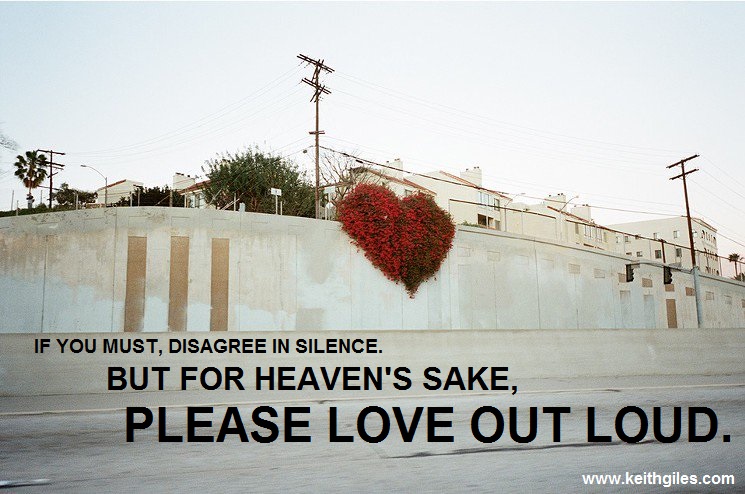
HOW IMPORTANT IS IT TO BE RIGHT?


Is Christianity ultimately about being right? Or is it about following Jesus?

See, if Christianity is about being right then it's easier to justify cutting off those people you don't agree with. Because, if you see Christianity as a quest for “rightness” then being wrong is the greatest sin of all.

However, if you see Christianity as following Jesus, then being right is less important than the quality of your relationship with Him.

Relationships are messy. They’re not about correctness, or accuracy. No one measures their relationships in such terms. Instead, we gauge the health of our relationships based on how open our communication is, and how honest we can be with one another, and how much time we spend together.

Jesus also connects our obedience to His commands with our love for Him. It’s all through the Gospel of John, especially in John 14.

He also equates our love for Him with how we love one another. If we love one another as He has loved us – which is one of His commands – then we are loving Him by our obedience, and by being obedient we are loving others, too.

Elsewhere, Jesus connects our horizontal relationships with our vertical one towards God. He tells us that we should go and reconcile with our brother before we return to complete our acts of worship. And the Apostle John pushes it further by saying that if we claim to love God but don’t love our brothers and sisters, we’re just liars.

So, what should we learn from this? Perhaps that our interpersonal relationships don’t need to hinge on agreement with one another.

I can love someone who has the wrong ideas about doctrine. I can fellowship with a brother who sees things differently than I do. I can extend grace to a sister who calls me a heretic.

Are they wrong? Maybe. But perhaps I’m the one who is off base? Until we know for sure, our main goal should be to love one another as Christ has loved us.

In the early church, for example, there were three different views of the doctrine of hell. For nearly 300 years none of those people considered the others to be "heretics" or worthy of excommunication or disqualified from the faith.

It was only after Constantine shifted the paradigm of Christianity from a focus on Christlikeness [orthopraxy] to one of Correctness [orthodoxy] that Christians started persecuting one another over differences of opinion in matters of faith.

So, nowhere do we get the idea that the Gospel is about having the correct information. Instead, it’s about having a transformational relationship with Jesus.

This relationship involves abiding in Christ as He abides in us. Through this process, our sinful self is daily crucified and our spiritual self – the “new creature” – is brought to life within us.

It’s a constant exchange of death for life where the resurrection power of Christ is increasingly revealed in us and transforming us into people who are like Him.

So, in summary, if the Gospel is about having the right information, then being right is everything.

But, if the Gospel is about transformation, then being Christlike is everything.

Let go of the need to “be right” and begin to embrace the reality of Christ’s transformational life in you!

We’re all in process. None of us is right about everything. Thankfully, we don’t need to be.

We just have to keep abiding in Him.

Peace,

kg
WATCH THE VIDEO

Tuesday, April 14, 2015

Guest Blog: Reflections on Indiana Law by Donna Savage


NOTE; This guest blog article was written by a dear friend of mine, Donna Savage. I worked with her for many years at Vineyard Music Group. She is a follower of Jesus, and a friend, and she is Gay. 

I ask that you, my readers, listen to what she has to share and please, dear ones, temper your comments with much love. I will post a blog here later in the week with my own thoughts and comments about this post.

Thanks,

-kg
**

I find it interesting as I read and listen to the different opinions on the whole Indiana "Religious Freedom Restoration" ordeal. The proponents for this law consistently speak of how this law protects people of faith in juxtaposition to the liberal's agenda of tolerance.

Can I just say that there are many, many liberals who are people of faith. I am a person of faith. Yet, because I am also a lesbian, am I automatically considered a liberal... with no faith? I'll be the first to say that many of my viewpoints are liberal. I, however, hold many conservative viewpoints, as well. There is a delicate balancing act I find myself in as I try to live authentically in community with both my liberal and conservative friends.

What I would like you to hear, is that as a liberal, I do not take my relationship with God lightly. If you know me well, you know that my faith in God is not only central in my life, it is based on my understanding and belief of, not only God's love for me, but his love for all of us. When I hear comments about this law that polarize the sides, as people of faith vs. the liberals, I struggle with trying not to be offended. Namely, because as I have said, I am a person of faith, as well as, a lesbian, as well as, a liberal-conservative.

If I lived in Indiana, the religious freedom law would not protect me as a person of faith. Although I have faith, I would still be penalized due to being a lesbian. Not all "people of faith" are being protected by this law. The reality is that doctrinal interpretations have now been attached to our legal system. Today it is legal to not sell to a gay person... tomorrow, will it be legal to kill a gay person for being gay? (There is an initiative being proposed for that very thing here in California! It's not as far fetched as you may think!) This subtle law in Indiana only protects a segment of Americans. It merely protects the faith or beliefs of a certain group of people, who hold a certain doctrine. In my understanding, this is discriminatory.

And this law, in my opinion, is the antithesis of the words written in our constitution, "We hold these truths to be self-evident, that all men are created equal,..."

If there are laws to keep me out of the public market place due to our differences in doctrine, than that is discrimination and I am not being treated as an equal.

Governor Pence said, "There needs to be tolerance on both sides."

The difference in our tolerance is this: the laws that enable me to marry the person I love does not ask or compel a heterosexual to become a homosexual for my marriage to take place. It merely provides me with the same civil liberties and rights that heterosexuals enjoy. I promise that if I ever get married, I will never require my heterosexual friends to become homosexuals! I not only tolerate your heterosexuality, I think it's great... for you! However, with this law, which protects business owners who hold the doctrine or viewpoint that who I am is sinful and therefore, they are not required to treat me as an equal and sell their goods to me... unless, of course, I stop sinning and become a heterosexual like them, is just... intolerant and quite frankly, ugly.

I think it is safe to say, if I should get married, and I am protected under the law to do so, you as a heterosexual, will not die. However, hypothetically speaking, every store owner in any given city in Indiana could legally hold this religious freedom restoration viewpoint and be protected by the law in doing so. If I, as a liberal lesbian, lived there and could not buy food, I could literally die of starvation. How can that ever be ok? Their faith/doctrine is now protected over and above my right to life? Exaggerated... yes, but now a possibility. In my mind, there is a huge difference between the tolerance we are asking each other to live by.

There is an ugliness that this law shadows. It doesn't protect people's beliefs, it protects their judgments.

As a Christian, as a lesbian, as an American, and as a human being, the Religious Freedom Restoration Act is offensive to me. I applaud any person or organization who protests, boycotts, or advocates against this law in Indiana or in any other state in our country. Remember Martin Luther King's words, "Injustice anywhere is a threat to justice everywhere." This law is a threat to justice everywhere.

-Donna Savage


Wednesday, February 25, 2015

EPISODE 3: Dan Notti and Keith Giles Podcast: Doctrine and Ekklesia: Where Do They Fit?


In our third Skype Podcast, Dan and Keith discuss what place Doctrine and Teaching hold in the Ekklesia. 

We also touch on issues like homosexuality, fornication, and church discipline, as well as personal struggles with finding balance in our own christian fellowship with regard to teaching, doctrine, disagreements and how to love one another as Jesus taught us.

NOTE: This is an audio-only recording.


Wednesday, April 29, 2009

The Gospel According to Philip K. Dick

In case you don’t know, Philip K. Dick (PKD) is one of the most prolific and unique science fiction authors of the 20th century. He's also one of my favorite authors of all time. His novels (36 of them) and short stories (121 of those) explore philosophical themes and metaphysical concepts including the nature of reality, and the questions of sanity, perception, identity and spirituality.

Several of his novels have been made into films since his death in 1982. Most notably, “Do Androids Dream of Electric Sheep?”, (which became the basis for the film “Blade Runner”), and “Minority Report”, as well as “A Scanner Darkly” and “Total Recall”. However, his body of work has yet to be fully discovered by Hollywood just yet, and that is fine with me seeing as most of his ideas have been ruined by film and not particularly enhanced by it.

As a resident of Orange County, California, I am also interested in the fact that PKD lived and died here. His novels include streets and restaurants that I am familiar with. The library near my house includes several first editions of his books with authographs on the inside front cover. This is the very place that PKD lived his life and wrote most of his stories.

I recently read (and reviewed) his book “Radio Free Albemuth” (HERE) which was discovered and published after his death. In the book, Dick incorporates many of his own spiritual, political and philosophical views into the story, even going so far as to include his own personal experiences as well.

The book is about PKD himself as a main character and also a fictitious person named Nicholas Brady who begins receiving messages and visions from a being who may, or may not, be God Himself.

At one point near the end of the book, PKD encounters a former pastor while he is imprisoned for crimes against the fascist dictator of America. The pastor, Leon, and PKD engage in a dialog about several of their friends who have died and entered a better, spiritual reality.

“Did believing that, about a heavenly father, get them anywhere?” Leon asked presently.

“Not in this world, maybe,” I said.

“Then I’m going to tell you something you maybe don’t want to hear. If your friends were here I’d tell them too. It’s not worth it, Phil. It has to be in this world.” Leon nodded firmly, his lined face hard. Hard with experience.

“They gained immortality,” I said. “It was conferred on them, for what they did, or even what they tried to do, and failed to do. They exist now, my friends do. They always will.”

“Even though you can’t see them.”

“Yes,” I said. “Right.”

Leon said, “There has to be something here first, Phil. The other world is not enough.”

I could think of nothing to say: I felt broken and feeble, my arguments used up during all that had happened to me. I was unable to answer.

“Because,” Leon continued, “this is where the suffering is. This is where the injustice and imprisonment is. Like the two of us. We need it here. Now.”
I had no answer.

“It may be fine for them,” Leon said, “but what about us?”

“I—“ I began. He was right and I knew it.

Later on Leon concludes this conversation by saying:

“I’m sorry,” Leon said. “I can see you loved your two friends and you miss them, and maybe they’re flying around somewhere in the sky, zipping here and there and being spirits, and happy. But you and I and three billion other people are not, and until it changes here it won’t be enough, Phil; not enough. Despite the supreme heavenly father. He has to do something for us here, and that’s the truth. If you believe in the truth…well, Phil, that’s the truth. The harsh, unpleasant truth.”

While the rest of the novel is anything but an endorsement of Biblical Christianity, I read this section above and marveled at how close PKD came to the Kingdom. This is exactly what Jesus was proclaiming when he preached the Gospel of the Kingdom – “the Kingdom of God is at hand”, “the Kingdom of God is within”.

If even a sci-fi writer in Orange County, California can see the Kingdom and understand that it must happen here or it doesn’t matter, then perhaps there’s hope for the people of God to get it too?

“…thy Kingdom come, thy will be done, on Earth as it is in Heaven..”

The Church, the Body of Christ, the ambassadors of Jesus, the citizens of the Kingdom, must become agents of change in this world, in their own neighborhoods, in their actual workplace, so that people can see the love that defies logic and the peace that passes understanding. The followers of Jesus must not only proclaim the Gospel of the Kingdom, they must (like Jesus) demonstrate the compassion of God for the poor, the broken, the outcast, the lonely, and the marginalized.

“Blessed are the drugged out, poverty-level science fiction writers in Orange County, California, for they shall see the Kingdom of God and publish it in their writings for people to read long after they are dead.” – kg

Tuesday, January 06, 2009

ATHEIST BELIEVES AFRICA NEEDS JESUS

Just wanted to share a fascinating article I found today. Atheist Matthew Parris explains why Christianity is necessary to turn Africa around as a nation.

Here's an excerpt:

"Christianity, post-Reformation and post-Luther, with its teaching of a direct, personal, two-way link between the individual and God, unmediated by the collective, and unsubordinate to any other human being, smashes straight through the philosphical/spiritual framework I've just described. It offers something to hold on to to those anxious to cast off a crushing tribal groupthink. That is why and how it liberates.

"Those who want Africa to walk tall amid 21st-century global competition must not kid themselves that providing the material means or even the knowhow that accompanies what we call development will make the change. A whole belief system must first be supplanted.

"And I'm afraid it has to be supplanted by another. Removing Christian evangelism from the African equation may leave the continent at the mercy of a malign fusion of Nike, the witch doctor, the mobile phone and the machete."

READ THE WHOLE ARTICLE
HERE