Saturday, July 19, 2014

Questions about the Old and New Covenant.


Why do you say the Old Covenant is “obsolete”?

Because in Hebrews 8:13 we read:

“By calling this covenant "new," he has made the first one obsolete; and what is obsolete and aging will soon disappear.”

But, how can the OT be obsolete if Jesus said he did not come to abolish the Law but to fulfill it?

Jesus said: “Do not think that I have come to abolish the Law or the Prophets; I have not come to abolish them but to fulfill them. I tell you the truth, until heaven and earth disappear, not the smallest letter, not the least stroke of a pen, will by any means disappear from the Law until everything is accomplished.” ( Matthew 5:17-18)

There are two qualifiers here: One is that the Law will not disappear “until Heaven and Earth disappear”, and the second qualifier is that the Law will not disappear until “everything is accomplished.”

So, first Jesus assures us that His mission is to fulfill or to accomplish the Law, and then He tells us that the Law will not disappear “until everything is accomplished.”

The question is: “Was everything accomplished?”

And the answer is: Yes!

“When he had received the drink, Jesus said, "It is finished." With that, he bowed his head and gave up his spirit.” (John 19:30)

The Greek word Jesus used here is literally “accomplished”.

So here, on the cross, Jesus declares that He has accomplished His mission to “fulfill the Law”, just as He set out to do.

What does that mean, then, according to the two qualifiers Jesus placed on the Law? It means that since everything has been accomplished, the Law has now disappeared.

Maybe this is why Paul the Apostle told us that, on the cross, Jesus actually DID “abolish the Law” by fulfilling (or “accomplishing”) it?

"For He Himself is our peace, who made both groups into one, and broke down the barrier of the dividing wall, by abolishing in His flesh the enmity, which is the Law of commandments contained in ordinances, that in Himself He might make the two into one new man, thus establishing peace." (Eph. 2:15)

Elsewhere Paul also affirms for us that “Christ is the end of the law.”  (Rom. 10:4).

Furthermore, Paul explains for us the differences between the Old Covenant and the New Covenant – not once but twice.

The first time, in 2 Corinthians, Paul contrasts the Old and the New Covenant saying:

“Now if the ministry that brought death, which was engraved in letters on stone, [that’s the Old Covenant] came with glory, so that the Israelites could not look steadily at the face of Moses because of its glory, fading though it was, [the Old was “fading”] will not the ministry of the Spirit [that’s the New Covenant] be even more glorious?”

“If the ministry that condemns men [the Old] is glorious, how much more glorious is the ministry that brings righteousness! [that’s the New] For what was glorious [the Old] has no glory now in comparison with the surpassing glory. And if what was fading away [the Old] came with glory, how much greater is the glory of that which lasts! [the New] - (2 Corinthians 3:7-11)

So, Paul tells us the following about the Old Covenant:
  • ·         It brought death
  • ·         Its glory was fading
  • ·         It condemns men
  • ·         It was glorious (past tense)
  • ·         It now has no glory
  • ·         It is fading away

The New Covenant, in contrast :
  • ·         Is More glorious than the Old Covenant
  • ·         Brings righteousness
  • ·         Has a glory that is surpassing
  • ·         Is everlasting

The second contrast and comparison that Paul does between the Old and the New Covenant is here in Galatians:

"The women (Hagar and Sarah) represent two covenants. One covenant is from Mount Sinai and bears children who are to be slaves: This is Hagar. Now Hagar stands for Mount Sinai in Arabia and corresponds to the present city of Jerusalem, because she is in slavery with her children. But the Jerusalem that is above is free, and she is our mother." (Galatians 4:24-26)

"But what does Scripture say? “Get rid of the slave woman and her son, for the slave woman’s son will never share in the inheritance with the free woman’s son.” Therefore, brothers and sisters, we are not children of the slave woman, but of the free woman." (Gal.4: 30-31)

Now what does Paul say about the Old Covenant?

The Old Covenant:
  • Is from Mount Sinai (where the 10 Commandments were given)
  • ·      Bears children who are slaves
  • ·      Corresponds to the earthly Jerusalem
  • ·       Is in slavery with her children
  • ·       Should be cast out of our presence
  • ·       Will not share in the inheritance of Christ
  • ·       Is not our Mother

Paul says the New Covenant:
  • ·         Bears children who are free
  • ·         Is of the heavenly  New Jerusalem, not the physical city
  • ·         Is our true Mother
  • ·         Shares in the inheritance of Christ

To drive the point home even further, Paul tells us many times:

"We are not under the law" (Rom. 6:14; Gal. 5:18).
“We are dead to the law” (Rom. 7:4).
“We are delivered from the law” (Rom. 7:6).

Therefore, those who are in Christ are not under the Ten Commandments but under the “Law of Christ” as Paul says:

“Carry each other’s burdens, and in this way you will fulfill the law of Christ.” (Galatians 6:2)

But what about the Jewish people, then? Aren’t they God’s Chosen people?

That depends on what you mean by “Israel” and “Chosen”. Paul pointed out to us that not everyone who claims to be “Israel” is actually, truly “Israel” in God’s eyes.

 "For not all who are descended from Israel are Israel. Nor because they are his descendants are they all Abraham’s children." (Romans 9:6)

John the Baptist said the same thing to the Pharisees who wanted to claim that they were “Children of Abraham” (or “Israel”) and therefore blessed and favored of God. He said to them:

“And do not think you can say to yourselves, ‘We have Abraham as our father.’ I tell you that out of these stones God can raise up children for Abraham. The ax is already at the root of the trees, and every tree that does not produce good fruit will be cut down and thrown into the fire.” (Matt. 3:9-10)

So, the true “Israel of God” is actually found in Galatians where Paul assures us that:

"If you belong to Christ, then you are Abraham’s seed, and heirs according to the promise." (Galatians 3:29)

Where does that leave the unbelieving Jewish people? The answer is troubling, and it should give us sincere pause and cause us to fall on our knees and cry out to God for their salvation.

Consider this:

"Who is the liar? It is whoever denies that Jesus is the Christ. Such a person is the antichrist—denying the Father and the Son." (1 John 2:22)

The Jewish people today who deny Jesus is the Messiah have neither the Father, nor the Son. They are anti-christ and they are lost without Him.

But I thought they were God’s “Chosen” people?

Consider what the Apostle Peter says about the Christians he writes to in his epistle:

But you are a chosen people, a royal priesthood, a holy nation, God’s special possession, that you may declare the praises of him who called you out of darkness into his wonderful light. Once you were not a people, but now you are the people of God; once you had not received mercy, but now you have received mercy.” (1 Peter 2:9-10)

Who, then, is the true Israel of God according to the New Testament?

Anyone who is in Christ.

Who are the “Chosen people” of God?

Those who put their hope in Jesus as their Lord and King.

So, the Jews are no longer the “Chosen people of God”?

Let’s go back and look at what the Jewish people were “Chosen” for in the first place. Were they chosen to be saved? No, because salvation depends upon trust in Christ as Lord and Savior.

What we find is that God chose the Jews to be the people group from whom the Messiah would be born.  That’s it.

So, since Jesus was born a Jew, they have fulfilled their calling. There’s nothing more for them to be “chosen” for.

Christians, according to Peter, are now the “Chosen of God” to carry the message of the Gospel to every nation. This is our calling as God’s “chosen people”.

How can you say the 10 Commandments are no longer relevant for Christians today?

Because the 10 commandments were the terms of the Old Covenant (which is obsolete and vanishing).

“Moses was there with the Lord forty days and forty nights without eating bread or drinking water. And he wrote on the tablets the words of the covenant—the Ten Commandments.” (Exodus 34:28)

“He declared to you his covenant, the Ten Commandments, which he commanded you to follow and then wrote them on two stone tablets.” (Deut. 4:13)

The Ten Commandments are only mentioned (by name) three times in the entire Bible. Here in these two scriptures referenced above, and also in Deut.10:4. But in each case it is clear that God gave the Ten Commandments to the Jews as a Covenant. (Note: There are many other terms used such as “Tablets of Stone”, “Stone Tables”, etc.)

Also because the 10 Commandments were a covenant between Himself and with the Nation of Israel, not with the entire world:

“Then the Lord said to Moses, “Write down these words, for in accordance with these words I have made a covenant with you and with Israel.” (Exodus 34:27)

Without this Covenant, the Jewish people had no basis for being called a nation. If this Covenant was in force, then they would have a claim to the promises included in the Covenant, but if they broke this Covenant then they would lose all their status as God’s chosen people and their status as a nation.

“Now if you obey me fully and keep my covenant, then out of all nations you will be my treasured possession. Although the whole earth is mine, you will be for me a kingdom of priests and a holy nation.’ These are the words you are to speak to the Israelites.” (Exodus 19:5-6)

In much the same way that the Constitution is a document that outlines the laws of our nation and establishes our system of government, the Ten Commandments (or the Law) outlines God’s terms for establishing the nation state of Israel.

The terms of Israel’s nationhood are dependent upon a few things. First, it says, “If you obey me and keep my covenant, THEN you will be my treasured possession.”

That’s a conditional covenant. We know that the History of Israel records their continual disobedience to God and to His covenant. Because they broke their covenant with God, they were scattered over and over again, until finally they nation of Israel was judged in AD 70 during the destruction of Jerusalem by the Romans, as Jesus predicted it would be (Luke 21) and in the Parable of the Vineyard (Matt. 21:33-46).

Did you know that the promises connected to the Old Covenant have now been offered unconditionally to those who are under the New Covenant?

It’s true! The very same conditional covenant terms spoken to the Jews are repeated in the New Testament as being unconditionally applied to the Church:

“As you come to him, the living Stone—rejected by humans but chosen by God and precious to him— you also, like living stones, are being built into a spiritual house to be a holy priesthood, offering spiritual sacrifices acceptable to God through Jesus Christ.” (1 Peter 2:4-5)

“But you are a chosen people, a royal priesthood, a holy nation, God’s special possession, that you may declare the praises of him who called you out of darkness into his wonderful light.Once you were not a people, but now you are the people of God; once you had not received mercy, but now you have received mercy.” (1 Peter 2:9-10)

Here, Peter declares that Christians “ARE a chosen people, a royal priesthood, a holy nation, God’s special possession…”. The very same conditional promises originally offered to the Jewish nation in Exodus 19:5-6 are now spoken to the Church as being now in effect. So that anyone who is currently found in Christ is the recipient of these promises to be chosen, of the priesthood, a holy nation and God's special possession. We are also promised to be called the people of God and to receive mercy.

The Good News is that Jesus first came and fulfilled the terms of the Old Covenant, and then He made a New Covenant with anyone who would receive Him as Lord and Savior.

THE TERMS OF THE NEW COVENANT

 “I will put my law in their minds and write it on their hearts. I will be their God and they will be my people…and they will all know me from the least to the greatest for I will remember their sins no more.” (Jer. 31:33-34 and Hebrews 8:7-9)

We are now under one Covenant, not two. The first has been fulfilled and is now obsolete:

“In speaking of a new covenant, he makes the first one obsolete. And what is becoming obsolete and growing old is ready to vanish away.” (Hebrew 8:13)


 -kg

[Subversive Radio Podcast] Peace In The Middle East by Keith Giles


What will it take to bring real, true, lasting peace in the Middle East? Listen as Keith shares some ideas that just might reveal a spark of hope for actual peace between Jews Muslims and Palestinian Christians.

Thursday, July 17, 2014

[Subversive Radio Podcast] Let's Talk About Israel.

Why is it so hard for Christians to talk about Israel? And what is at stake if we get it wrong?

In this podcast, Keith explains why it matters and how misunderstanding this key New Testament teaching can distort our views of the Church, our purpose and our identity in Christ.


Saturday, July 12, 2014

[Subversive Radio Podcast] The Obsolete Old Testament?


The Old Covenant had a great run for a few thousand years, but now it is old, and fading, and obsolete and vanishing - at least according to the New Testament it is.

Listen for yourself as Keith explains why the Ten Commandments and the Old Covenant are no longer binding for anyone, especially those who are in Christ.


Thursday, July 10, 2014

Hard Lessons


Love is painful.

It is also beautiful, sublime, fantastic and awesome.

But love is also painful.

The sooner we learn this, the sooner we can move on to maturity in our faith, and in our life.

**
We all stood together in a semi-circle under the late afternoon sun, our heads hanging low.

Our eyes red with tears.

"Do you want to say anything?" my wife asked my sons. There was a silent pause as we stood around the hole my wife had dug in the ground near the back fence.

"No," my youngest said.

"It's not fair," my oldest said.

And it wasn't.

A few hours ago my youngest son had found her body, what was left of her, in our back yard.

"I found Little Momma," David said over the phone. "She's dead."

Those words hit me hard. I knew they would hit my wife and my oldest son even harder.

But now here we were, standing around this hole in the ground and doing our best to hold our emotions in check.

There were many lessons to be learned in that moment. Most of them went unspoken. But I did my best anyway.

"She was a gift to us," I said. "She knew that we loved her, very much."

It didn't take the pain away. It might even have made it worse. I'm not sure.

One quote that came to my mind in that moment, as I leaned against the shovel, went unspoken. It was a quote by C.S. Lewis that says:

"To love at all is to be vulnerable. Love anything and your heart will be wrung and possibly broken. If you want to make sure of keeping it intact you must give it to no one, not even an animal. Wrap it carefully round with hobbies and little luxuries; avoid all entanglements. Lock it up safe in the casket or coffin of your selfishness. But in that casket, safe, dark, motionless, airless, it will change. It will not be broken; it will become unbreakable, impenetrable, irredeemable. To love is to be vulnerable.”

Later, when we had said all we could say, when we had each placed our own handful of dirt over her, when I had buried what was left of her and our boys had slowly walked back into the house, my wife and I stood alone on the grass.

We reflected on what our boys would learn from this; how it would affect them at this stage of their life. My wife suggested that it would help them to develop more compassion for the pain of others; that it would soften their hearts more.

We both remembered the pain that others we know are suffering now. The passing of a brother, or the end of a marriage, or the sudden death of a spouse.

We were the lucky ones. In comparison, our pain was minimal, yet still deep enough to take our breath away. Real enough to make us thankful for what we still have left to hold on to.

There is a saying - a myth really - that Christians often quote to one another in times of suffering. They say, "God never gives us more than we can handle." As if our suffering is proportional to our level of faith. As if our friends die because we're too spiritual, or our children get sick because we're so close to God?

No.

The scripture we mangle to arrive at this platitude is actually about being tempted and God always giving us a way to escape that temptation.

The truth is that God almost always gives us more than we can handle.

Because He loves us. Because He wants us to know that we can lean on Him - hard - for everything that life can possibly throw at us.

God portions out our suffering in relation to our need to know that He is able to carry us through it.

Because of love. Which is beautiful, and marvelous, and wonderful, and yes, sometimes, very painful.

Our promise is not that we will never endure suffering. Our promise is that, when we do, we will not endure it alone.

He is with us. He will never forsake us.

We will never have to say goodbye to Him, or His love.

For that we are very grateful.

-kg

Monday, June 30, 2014

GUEST BLOG: Two-Sides To The Cross by Brandon Chase


The Path of Jesus led Him up a hill with a Cross on His back. Ultimately, He would be nailed to this Cross, and breathe His last upon it.

Those who seek to come after Him will assuredly encounter the same.
“Christ also suffered for us, leaving us an example, that you should follow His steps
Most Christians are only familiar with one side of the Cross, that being of the side of Christ bearing the weight of the world’s sins, ultimately to death, for our atonement and Salvation. Thank God for this finished work that makes us one with Him.
But Christ was not only on the Cross, suffering for us; He was on the Cross as an example for us. The first side of the Cross is for the sinner; the second side for the follower, the disciple. The Gate was for the sinner; The Path is for the follower.
Jesus said the way to The Path, The Gate, was narrow. He is the only Way. But as The Gate is narrow, so too is The Path, and few find it.
But Jesus said that Life was at the end of The Path, not at the beginning, just inside The Gate. Again, He was speaking of something much richer than an ending destination of Heaven versus Hell. He was speaking of an Eternal reality of Divine Abundance in Life in the Kingdom now.
This is a process. This Life, while promised at the end of The Path, is realized little by little along the Way – as He is increased, and we are decreased. This is the Law of Life. He will become more; we will become less. Life and Freedom are manifested in the process.
Jesus is both Substitute and Example; both Savior and Lord; both Author and Perfecter; both the Narrow Gate and the Difficult Path.
If there is any doubt as to the reason for a lack of Freedom in our lives as Christians, we need only examine our ultimate posture towards the Cross. Is the Cross something that Jesus saved us from, or something that Jesus saved us for? The fruit, or the lack thereof, will bear witness either way. The fruit of Freedom cannot be ripe and abundant without the full, two-sided work of the Cross.
So we may ask: Can we enter the Gate but not walk the Path? Can we be saved and go to heaven and not follow? Can Jesus be Savior and not Lord? I believe, as I’ve said, that these can, by His Grace. But this forfeits so much, and is most assuredly not Freedom. So my question to the question is then:
How free do we want to be?
Freedom is not merely embracing one side of the Cross, the side for Salvation, or simply Jesus as The Gate, as Savior. We must “continue” in His Word. We must put what we say we believe into action. We must make our faith seen in works. Jesus said make disciples, not simply believers. He wants a people who will follow Him in The Path, not just step through The Gate.

Jesus’ side of the Cross was done for us, 2000 years ago, once and for all, for our Salvation, the forgiveness of our sins – The Gate. Our side of the Cross is required of us daily, a continual following in discipleship, for our Spiritual Growth, maturity and Freedom – The Path.

Jesus came to announce a new King and a new Kingdom. This is the full Gospel. When we die, we then are raised – new species as citizens of this new, upside-down Kingdom, where:

*Wisdom is foolishness
Winning is losing
Lower is higher
* Servants are leaders
* Power is weakness
Life is through death
The Kingdom Way, the Way of Freedom, is not to be delivered from death, but to be delivered by death, and through death, as resurrected into a new Life, one that is no longer ours. An acorn must fall to the ground and die to fulfill its purpose – that not only a new tree would grow in its place, but an entire forest of trees!

“Truly, truly, I say to you, unless a grain of wheat falls into the earth and dies, it remains alone; but if it dies, it bears much fruit.” –Jesus Christ

-Brandon Chase

**

Go check out Brandon's blog, Zōē Perissos (www.brandonchase.net), and make sure and subscribe (http://brandonchase.net/subscription-form/) to receive all of his blog posts, as well as the FREE eBook The Path of Freedom: Few find it. Fewer walk it. Be one of the few."


Monday, June 23, 2014

[SUBVERSIVE PODCAST] Casting My Cares On Him


We all know that scripture tells us to cast our cares upon the Lord because He cares for us, but what about when we do that and nothing happens? We still have our pain, our sadness, our despair and our loneliness. What good is that?

In this podcast, Keith shares some intimate and honest reflection on what the Lord has been showing him about how to actually receive the peace and joy that God intends us to take away when we actually cast our cares upon the One who loves us.


Thursday, June 19, 2014

The Gospel According to Philip K. Dick


In case you don’t know, Philip K. Dick (PKD) is one of the most prolific and unique science fiction authors of the 20th century. He's also one of my favorite authors of all time. His novels (36 of them) and short stories (121 of those) explore philosophical themes and metaphysical concepts including the nature of reality, and the questions of sanity, perception, identity and spirituality.

Several of his novels have been made into films since his death in 1982. Most notably, “Do Androids Dream of Electric Sheep?”, (which became the basis for the film “Blade Runner”), and “Minority Report”, as well as “A Scanner Darkly”, "Adjustment Bureau" and “Total Recall”. However, his body of work has yet to be fully discovered by Hollywood just yet, and that is fine with me seeing as most of his ideas have been ruined by film and not particularly enhanced by it.

As a resident of Orange County, California, I am also interested in the fact that PKD lived and died here. His novels include streets and restaurants that I am familiar with. The library near my house includes several first editions of his books with authographs on the inside front cover. This is the very place that PKD lived his life and wrote most of his stories.

I recently read (and reviewed) his book “Radio Free Albemuth” which was discovered and published after his death. In the book, Dick incorporates many of his own spiritual, political and philosophical views into the story, even going so far as to include his own personal experiences as well.

The book is about PKD himself as a main character and also a fictitious person named Nicholas Brady who begins receiving messages and visions from a being who may, or may not, be God Himself.

At one point near the end of the book, PKD encounters a former pastor while he is imprisoned for crimes against the fascist dictator of America. The pastor, Leon, and PKD engage in a dialog about several of their friends who have died and entered a better, spiritual reality.

“Did believing that, about a heavenly father, get them anywhere?” Leon asked presently.

“Not in this world, maybe,” I said.

“Then I’m going to tell you something you maybe don’t want to hear. If your friends were here I’d tell them too. It’s not worth it, Phil. It has to be in this world.” Leon nodded firmly, his lined face hard. Hard with experience.

“They gained immortality,” I said. “It was conferred on them, for what they did, or even what they tried to do, and failed to do. They exist now, my friends do. They always will.”

“Even though you can’t see them.”

“Yes,” I said. “Right.”

Leon said, “There has to be something here first, Phil. The other world is not enough.”

I could think of nothing to say: I felt broken and feeble, my arguments used up during all that had happened to me. I was unable to answer.

“Because,” Leon continued, “this is where the suffering is. This is where the injustice and imprisonment is. Like the two of us. We need it here. Now.”
I had no answer.

“It may be fine for them,” Leon said, “but what about us?”

“I—“ I began. He was right and I knew it.

Later on Leon concludes this conversation by saying:

“I’m sorry,” Leon said. “I can see you loved your two friends and you miss them, and maybe they’re flying around somewhere in the sky, zipping here and there and being spirits, and happy. But you and I and three billion other people are not, and until it changes here it won’t be enough, Phil; not enough. Despite the supreme heavenly father. He has to do something for us here, and that’s the truth. If you believe in the truth…well, Phil, that’s the truth. The harsh, unpleasant truth.”

While the rest of the novel is anything but an endorsement of Biblical Christianity, I read this section above and marveled at how close PKD came to the Kingdom. This is exactly what Jesus was proclaiming when he preached the Gospel of the Kingdom – “the Kingdom of God is at hand”, “the Kingdom of God is within”.

If even a sci-fi writer in Orange County, California can see the Kingdom and understand that it must happen here or it doesn’t matter, then perhaps there’s hope for the people of God to get it too?

“…thy Kingdom come, thy will be done, on Earth as it is in Heaven..”

The Church, the Body of Christ, the ambassadors of Jesus, the citizens of the Kingdom, must become agents of change in this world, in their own neighborhoods, in their actual workplace, so that people can see the love that defies logic and the peace that passes understanding. The followers of Jesus must not only proclaim the Gospel of the Kingdom, they must (like Jesus) demonstrate the compassion of God for the poor, the broken, the outcast, the lonely, and the marginalized.

“Blessed are the drugged out, poverty-level science fiction writers in Orange County, California, for they shall see the Kingdom of God and publish it in their writings for people to read long after they are dead.” – kg

Wednesday, June 11, 2014

The Mechanics of Grace


The other day I spent some time with someone who has been through the meat grinder of life. He's endured the loss of a family member, the abandonment of his closest friends, and experienced a loss of passion in his career. That's only the beginning.

As he shared his heart with me I found I could identify with a lot of his pain. Not all of it, obviously, but much of what he confessed to me resonated with what I have been feeling lately.

Then he asked me to pray for him. So, as I began to lift him up in prayer to God I found that I was really praying for myself as well. I began to ask God for the same measure of blessing, and hope, and comfort, that I required in my own empty heart.

During the prayer I confessed to God, and to my friend, that I really don't know how to give God my burdens. Too often when I am depressed or discouraged I find something to distract myself from the pain. Rather than going to God with my problems, I turn to entertainment, or activities, or food, or other people, to help me forget the pain and dull the sorrow.

I know that we are told to "cast your cares upon Him, for He cares for you", and I really believe that all of that is true, but to be very honest, I'm not very good at doing that. Not at all.

So, as I prayed for this brother in Christ, I began to ask God to teach me, and to help my friend, to learn how to actually take our burdens, our pain, our suffering, our disappointments, and cast them at the feet of Jesus.

Again, I do not know how to do this. I know that God's word instructs me to do it. I know how to pray those words. I know how to say, "Jesus, I give you my pain. Please take this burden away." But I do not know how to actually leave my burden with Jesus. I don't know how to come to Him with my pain and walk away with hope. I don't know how to come to Him with defeat and walk away with joy. That is what I want to learn how to do. That's what I need to do.

Maybe you know what this feels like? Maybe you're struggling with some of the same issues of doubt, of defeat, of apathy, of sadness, of pain. Maybe you also tend to look for relief in places other than the presence of God. Maybe you turn to food, or television, or video games, or film, or sex, or drugs, or other people. If so, maybe you've already started to realize that those things do not work. They only delay the pain, at best, and accentuate the sensation of emptiness at worse.

Maybe, like me, you're ready to learn how to put these words of hope into practice. Maybe you're ready, out nothing more than desperation, to discover how to actually turn to Jesus with your pain and surrender your burden to Him, and walk away filled with hope and life and, yes, perhaps even joy.

How does it work? What are the magic words? How many steps are involved? Do I need to attend a seminar or purchase a book to make it click?

Here's what I believe: God knows that we are weak. He remembers that we are made from dust. If there were six steps then He would have told us what those were. Since He told us to simply "cast our cares upon Him because He cares" then, by faith, I think we need to start there.

By faith. That's the secret. We stop trying to map everything out and we just do what He says. We believe. We put our hope - all of it - in His power to heal us, and change us, and restore us.

We turn away from all of those other distractions that we have tried and failed to receive our hope and life and joy from, and we instead turn straight for Jesus with our pain. We come to Him first. We make turning to Him our first, and our immediate, act when the pain and the sorrow begins to wash over us.

This is what I have decided to do. I put my hope in Him. I trust in Him. I am calling His bluff because I am convinced it might not be a bluff at all.

"Why are you so downcast, oh my soul? I will yet praise Him, my savior and king."

-kg

Thursday, May 29, 2014

Subversive Radio Podcast: Do I Need To Love Myself?

Jesus commands us to love our neighbor as we love ourselves. So, does that mean we need to love ourselves before we can love others? Listen as Keith explains the meaning of this passage and connects it with the Leviticus 19 teachings on the "Shalom Community".

Wednesday, May 28, 2014

The Incarnational Gospel


One aspect of the Incarnation which fascinates me is how God, in human flesh, manifested Himself as a common, simple person born into humble circumstances who traveled the countryside telling stories.

Jesus was a storyteller. He was a creative personality. His stories were allegorical snapshots of what life inside the Kingdom of God was like.

Only one of his stories, which he called “Parables”, was ever actually explained to his disciples. All the rest he left up to interpretation and discovery.

The Parables of Jesus provoked thought and invited those who were curious to explore for themselves what the Kingdom of God was really all about. By internalizing the search for Truth contained in his stories, Jesus entrusted the human mind with the task of working it out in due time.

Jesus was comfortable with loose ends. He didn’t feel any anxiety over how many understood the parable. He knew that those who were truly hungry for real spiritual sustenance would discover what they were craving after in their own time.

There was an organic quality to the ministry and teaching of Jesus that appeals to me in ways that are deeper than I can even comprehend at a conscious level. He had ideas that were subversive to the status quo of the culture and he transmitted the code of this social rebellion through simple stories about farmers, widows, travelers, sons, fathers, and fields.

Jesus was comfortable with unanswered questions. In fact, I think that many of us who call ourselves his followers could learn something from adopting his style of asking questions and telling stories without getting hung up on the answers.

Too often we in the Church are too quick to provide answers to questions we’ve never been asked. That is a serious problem, in my mind. It paints us as people who are more concerned about results than we are about other human beings. We provide answers without taking the time to really listen to the questions being asked. Often we are answering the wrong questions.

For example, no one cares about your answer to spiritual poverty if you have yet to address the very real physical poverty all around you. When you show an indifference to the very real poverty that is easily detectable with the naked eye, it doesn’t paint you as someone who is particularly skilled at relieving poverty. Your poverty-relieving skills come into serious doubt.

Those who have yet to embrace Christ are skeptical of the slogan- “Jesus Loves You” when those who claim to be transformed by this love look and act just like everyone else.

It matters, then, who we are and what we do. Our reputation has become soiled. This is what makes the pursuit of personal Holiness and ethical behavior essential to the Christian life. Not just for our own personal need for sanctification, to be transformed into the image of Christ, but for the purpose of demonstrating that Jesus does indeed change lives and make us a new creation.

It shouldn’t take faith to believe that Jesus has the power to set us free. It should not take faith to accept that Jesus is capable of making us into better fathers and mothers and employees and citizens.

Our lives should serve as proof that Jesus is alive and transformation is possible.

-kg

Monday, May 19, 2014

The Hokey Pokey


"You put your left hand in, you take your left hand out..."

We do this all the time in our spiritual life. We surrender to Jesus on Sunday, and we take it all back on Monday morning. We mean well. We intend to serve Jesus with our life, but the daily pressures of life wear on us and we end up returning to the old patterns of life.

The good news is, God knows that we're dust. He knows we're weak. He understands that the flesh is willing, but the maturing of our spirits takes time.

"If we are faithless, He will remain faithful, for He cannot disown Himself."- 2 Tim 2:13

God is patient with us, and because of this we still have hope.

"...you put your right foot in, you take your right foot out..."

I've been tested lately about some of the same things I've been through many times before.

Why does God keep putting me through these tests of faith? I look to the sky and ask, "Haven't I already learned this lesson three times before? I thought I passed this. Why are we having to go through this again, Lord?"

A dear friend reminded me the other day that God's purpose for allowing challenges in our life is to draw us nearer to Himself. "We just want God to fix it, or do it, or make it better, but God wants us to take His hand and walk through these things alongside Him," my friend said.

Still, I'm weary of putting my faith into action again and again. I'm tired of wondering if God will work this miracle and save my family (again), or if this time we'll have to endure the pain.

God whispers to me, "Seek first the Kingdom of God, and His righteousness, and all of these things (food, shelter, daily needs, etc.), "will be taken care of as well."- Matt 6:33

So, I do my best to seek the Kingdom of God. I try to focus on Him instead of on my own challenges. But still I find myself drifting back to the question; "What if this time God doesn't rescue us?"

"...you put your whole self in, you take your whole self out, you put your whole self in, and you shake it all about..."

God wants all of me. He wants all of you. He wants my time. He wants my heart. He wants my trust. He wants my entire life. He wants my "whole self in".

Surrender to Jesus is, in reality, a gradual exercise in trust. It would be wonderful if that one time I went down front and bent my knees on the altar was enough. I wish it were true. Maybe for someone else it is true, but for me, I must confess, I'm still daily learning to bend my knees, surrender my heart, and trust Jesus with my life...with my entire life.

Maybe, in some strange way, the Hokey Pokey really IS what it's all about?

"You do the Hokey Pokey and you turn yourself around. That's what it's all about."

**

NOTE: Originally sent to the faithful subscribers of the [subversive underground] on 3/28/06


Friday, May 16, 2014

The Incarnation of Love by Mary Emily Duba


The Incarnation – by which we mean “God coming to dwell with us in the person of Jesus” – is God’s radical act of peacemaking. God subverted every expectation humankind had for what peace would look like; what the Messianic expectation was. The people of Israel were expecting a warrior King. Someone who would come to save the people through a military victory over their enemies and rule as this righteous warrior King. God subverted their expectation by coming in the form of a vulnerable and dependent infant.


For Christians, peacemaking begins with the body of Christ; with this child Jesus who has subverted every expectation we have for what peace – “shalom” – will look like.


Shalom is this state where “all is well”; where people have access to the food they need, the healthcare they need, the opportunity for just relationships with one another and with God and with the Earth. It’s more than what we think of as “peace”. It’s more than a cease fire. More than a starry night and songs around the campfire. It’s something much more holistic. Much more grand and whole. It’s God’s vision for the Universe as He created it to be. So the work of peacemaking, the practice of peacemaking, really begins there.


It’s about imitating Christ who is “the revolutionary face of the God of nonviolence.” I love that because it really encapsulates that this person of Jesus, this reconciling activity that God is doing in Jesus, is more than what we could have expected. It subverts our inclinations towards violence. And it subverts our idolatry of fear. That we would raise our fears to a level of an idol. That we would need to respond violently because we are so afraid. Because violence does reign in our world. And that’s a reality that we can’t escape. But we have the opportunity as Christians to choose not to idolize our fear. To choose instead to worship the One God who made heaven and earth and who’s vision for us is “shalom”.


Jesus tells a parable about a woman who puts just a little bit of yeast into a bowl of many measures of flour – enough for many dozens of loafs of bread – and he says, “This is like the Kingdom of God”. 

So, I think about yeast as this tiny little speck of life, this little growth that, even though it is tiny it can give life and leaven to the whole batch. So, I like to think of our acts of peacemaking – the Body of Christ in the world – as this little bit of leaven that, as small as it may seem in a world that is so incredibly violent, in a world that is at war, it is enough and more. It will give life and leaven to the whole creation. God has promised that it will be so. That what is small – these daily acts of peacemaking; those moments where we chose to not to say what we might have said, not to send the email that might have damaged a relationship, not to retaliate when we are provoked –those seemingly small choices give life and leaven to the whole bowl of wheat; the whole batch of creation.


God does not come as a warrior king. God comes as a baby. God’s power is hidden under the signs of vulnerability. God comes in poverty. God comes to a young woman who had no status in the community. God’s glory is hidden in the ugliness of our lives. In places of violence, in places of suffering, God is there, hidden among us. This is the theology of the cross. That in the horror of the cross, in the violence, in the ugliness, and the weakness of a man stripped and beaten and hung to die there is something more powerful at work. Hidden under these signs of weakness is the glory of God.


So as Christians we refuse to take up what the world sees as signs of power. We refuse - we don’t always, we fall short in this - But we want to say, “We refuse to be oppressors. We refuse to be dominators. We refuse all of the signs in the world that make for power.” 

Instead we choose weakness. We choose vulnerability. We choose to love. To have our hearts broken. We chose this because we know that under those signs, in the manger, among the cattle, on the cross, among the poor, God is there. We are not afraid of being poor. We are not afraid of imprisoned. We are not afraid of standing on the side of those who are weak. We are not afraid to be with God’s little ones. Because there is vulnerability, there is the glory of God. Where there is suffering God’s peace is stronger. No matter how hidden it may seem. In death there is abundant life.


God has already done the radical, the subversive revolutionary act of peacemaking and reconciliation in Christ. God has made peace between Himself and Creation. There’s no bigger gulf than that. There’s no bigger disconnect than between the Divine and the Human. All we have to do is make peace among human beings. 

God has done the radical thing. We just have to live into that promise.


- Mary Emily Duba

Thursday, May 15, 2014

Discovery


My friend Paul was sharing with me a story about a recent trip to the mountains where he had an odd spiritual experience. It all started while walking with some of his friends along mountain trails on their way to an overnight camp out. As he was crossing over a stream along the way he randomly picked up a rock to take along with him, something he did quite often on treks such as this one.

It wasn't a particularly interesting or colorful rock. He really had no specific motive for picking it up initially other than that it was black and it felt good in his hands. Almost reflexively he pulled the rock from the cold water, dried it on his shirt, and placed it in his pants pocket as they continued up out of the stream and up along a newfound trail.

As the group of friends made their way up the mountain they happened to pass an older gentleman coming down the same trail. After a brief bit of friendly chit-chat one of Paul's friends asked the older man if he had any words of wisdom for their group.

"You mean, like a mantra or something?" the old man asked. "Yeah, something like that," Paul's friend said.

The older gentleman took a short moment to reflect and then he said, "I’ve got just two words for you," he said. "The first is 'Immanuel', and the second one is 'Maranatha'". The group nodded their heads and smiled, and after a bit more brief chit-chat the two groups parted. However the conversation in Paul's group shifted to the words the older gentleman had shared with them and what they could possibly mean.

Eventually the group arrived at the cabin where they had planned to spend the evening. One of the women in the group asked Paul if he had ever prayed before. He said that he sometimes meditated in the mornings, but had really never prayed before. Something about the interaction with the old man made him feel like he should start to pray, or at least to try, the next time he was enjoying his morning meditation.

That very next morning, Paul woke up and went about his usual routine of meditation. He began to think about what had happened the previous day, and did his best to pray about those words and what meaning, if any, they might have for him. He was also holding on to the rock he had found in the stream the day before. The rock that he had selected at random and placed almost absently into his pocket was nestled into the palm of his right hand as he sat, eyes closed, on the floor.

Suddenly Paul felt the urge to open his hand to look closer at the rock. As he opened his hand and looked at it closer he almost did a double-take. There, clearly and naturally formed across one side of the stone was an unmistakable form of a cross.

Paul sat silently and looked at the rock. He wondered now even more about the meaning of the events of the previous day.

Sitting in my living room, telling me this story, Paul pulled out the rock and handed it to me. I was amazed at his story, and even more amazed to actually hold this rock in my hands. The shape of the cross was unmistakable, but clearly not man-made at all. The shape had been formed along the surface eons ago when the rock was first formed, and etched by the constant erosion of the stream it had been pulled from only weeks earlier. Now it was in my hand and I could easily imagine what Paul must have felt when he first opened his hand and realized the significance of the stone and the image that marked it.

I was reminded of the Proverb that says, "It is the glory of God to conceal a matter, and the glory of Kings to search it out." (Proverbs 25:2) Paul and I discussed the method that Jesus used to teach people about the Kingdom of God during his ministry on Earth, how he told stories that made people wonder and how he never seemed to answer a question unless it was with a question of his own.

Paul had been given a riddle of sorts and now had the privilege to work out what it all meant. Paul shared with me that, so far, all he knew for certain was that he was supposed to tell his story to people, and not just anyone, but people who would be likely to appreciate it. I felt honored to hold this stone in my hand and to have heard Paul's amazing story. It was with some reluctance that I handed it back to him.

In his search for the meaning of his experience, Paul had printed out the Wikipedia definitions of the words "Immanuel" and "Maranatha" and he unfolded the papers and passed them to me. He and I talked about these words and I expressed to him my sincere curiosity regarding his journey to discover the meaning of this rock that had found him in the stream. In many ways I envied my friend Paul for his opportunity to learn the meaning of this mysterious rock and the two corresponding words left to him by a stranger on the side of a mountain.

As far as I could see things, Paul had been given the words, "Immanuel" (which means 'God with us') and "Maranatha" (which means 'He has come'). He had been given a rock with a very obvious cross on it to accentuate those two words. A rock which he would not have picked up had they crossed the stream a few feet to the right or to the left, and which he admits he might not have picked up at all considering the randomness of his choice of stones there in the stream. He was also, finally, encouraged to pray and that next morning all of these various elements converged together to spark his imagination and his journey of discovery regarding the meaning of the message.

This is why Jesus loved to use parables to teach his disciples, so that when the meaning was finally discovered, the person would own the truth and treasure the revelation. When someone gives you the answer you don't value the information as much. When you're handed the keys you lose the thrill of the chase and the joy of discovery.

I pray that even more people will discover a stone in the stream or cross paths with wise old men bearing clues to the journey of life. We all need more questions to work out with fear and trembling. We all need to seek the Truth. Maybe the clues are already all around us? Maybe we're just not paying enough attention?

All creation cries out and pours forth speech, day and night. Sometimes even the rocks cry out.

-kg

[From the book, "The Gospel:For Here Or To Go?" by Keith Giles]

Wednesday, May 14, 2014

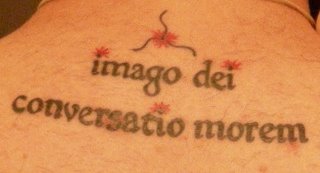
Conversatio Morem!


As I’ve been reading on the early church, I’ve come across a great saying used by the church fathers and I’d like to make it my own.


The phrase, “Conversatio Morem” can be translated two different ways, depending on the context. The first way is, “Death To The Status Quo”. I must say, I love this. It embodies the counter-cultural aspect of Christian discipleship that I long to embody and to inspire in others. If I ever have a tattoo, it will be of this statement.

The second way to translate this is, “Constant Conversion”. Again, I resonate with this sentiment very much. After studying the writings of Peter, James and Paul I see that they’re idea of salvation was very much a process. They all speak of “being saved” and seem to understand that following Jesus involves a gradual, daily transformation into someone who is like our Lord, and closer to someone who is fit for Heaven.

Our modern understanding of salvation seems to be much more about a single day or event in our lives where we went forward, said a prayer and maybe even filled out a little card. After that we can, and often do, live out the rest of our lives any way we want. If we get into trouble, or need some advice or a miracle, maybe then we will pray and ask God’s help, but mainly our lives after this sort of “conversion” are our own.

Paul, Peter and James see salvation as a lifelong process. All through the book of 1 Peter we see the famous disciple speaking of salvation as something which is occurring to us, or that we are in the process of receiving every day. "For you ARE RECEIVING the goal of your faith, the salvation of your souls." (1 Peter 1:9, etc.) Peter doesn't see salvation as something you take possession of until the day you’re actually at the Judgment Seat of Christ and it is then He saves you, in that day.

Paul especially sees salvation as being tied to our worship and our worship as being tied to our being living sacrifices (Romans 12). He also is pretty clear that “Your life is not your own; You were bought with a price.” (1 Cor 6:19-20)

We, of course, have the hope and the promise of salvation, but just like the Gospel, it’s about a daily, ongoing submission to Jesus.

I’m trying now to get my head around a daily, “constant conversion”. The Kingdom is about following Jesus, and Jesus said we can’t even begin to follow Him unless we daily take up our crosses and die to ourselves. (Luke 9:23)

Somehow, looking at my own walk with Jesus as an ongoing conversion helps me to maintain this counter-cultural mindset in my own life. Now, I understand now that "Death to the Status Quo" is really a personal cry for revolution in my own soul. It is my status quo that needs to be put to death.

Instead of seeing salvation as that day I came forward at the Lighthouse Freewill Baptist Church in Eagle Pass, Texas at the age of 9, now I see it as a daily surrender to Jesus. I walk the aisle every morning. I bend the knee every sunrise and give Him my heart, over, and over again.

Conversatio Morem!

**

NOTE: Originally sent to the subscribers of the subversive underground newsletter on Dec.21st, 2005.


Tuesday, May 13, 2014

POWER IS OUR MIDDLE NAME


APC: Power Is Our Middle Name

Very excited to share yet another example of my "day job" with you.

This time our client, APC, came to us wanting a video that established them as the "go-to" provider of computer network power supplies.

I came up with the tagline: "Power Is Our Middle Name" (which I was amazed no one had thought of before), and the client loved it.

I also wrote the script which remained totally unchanged (except the word "dream" was replaced with "envision") from concept to final version.

It's not often I am so excited about something I did for a client at work, but this video makes me smile.

Hope you like it.

Monday, May 12, 2014

My Eye For Yours?


"Fracture for fracture, eye for eye, tooth for tooth. The one who has inflicted the injury must suffer the same injury." - (Lev. 24:20)

What if God's intention with this law was to inspire His people to realize that if they injure another person (take their eye out, for example) that what they're actually doing is taking out their own eye?

Isn't this just the flip side of "Do unto others as you would have them do unto you?" It seems like just another way to phrase the same idea, doesn't it?

I can't help but wonder if this is exactly what God had in mind. The reciprocal nature of these commands seems intended to evoke such a response.

So, if I harm another person, I'm also harming myself in the exact same way. This should have inspired people to refrain from harming others because to do so would be to harm themselves.

It also helps us to realize that their pain is my pain, and that my pain is theirs. Especially in the "shalom" community in which people were often very much connected to one another for generations, the command in Leviticus seems designed to remind people that to harm others is to harm yourself.

Of course, Jesus takes it another step forward and says, "Bless those who curse you." (Luke 6:26-27)So, he is advocating for a proactive love rather than simply a passive refrain from harm or evil. But it's still two sides of the same coin, I believe.

The command in Leviticus seems almost like what you'd expect God to say to a people who didn't yet have the Holy Spirit living within them. In their flesh they should have understood that to take someone's eye, or their tooth, or property, etc. is to harm themselves and to lose their own eye, tooth, or property, etc.

Once Jesus arrived on the scene He expanded this idea to include proactive love and further pressed the concept of our connectedness as human beings.

"You have heard that it was said, ‘Eye for eye, and tooth for tooth.’ But I tell you, do not resist an evil person. If anyone slaps you on the right cheek, turn to them the other cheek also." (Matt. 5:38-39)


Jesus raises the stakes. He compels us to reject the simple "eye for eye" approach, perhaps because it was not producing the desired results. People were still focused more on the post-violence retribution than on pre-violence restraint. Therefore, Jesus turns it all around and commands us to accept the violence done against and refuse the right to do violence in return.

Why? Because we are all children of God made in His image.

Under the Law of Moses, then, if I harm you I am harming myself in the same way.

Under the Law of Love, if you harm me I turn around and bless you as if you were my friend or my brother.

“You have heard that it was said, ‘Love your neighbor and hate your enemy.’ But I tell you, love your enemies and pray for those who persecute you, that you may be children of your Father in heaven. He causes his sun to rise on the evil and the good, and sends rain on the righteous and the unrighteous.  If you love those who love you, what reward will you get? Are not even the tax collectors doing that? And if you greet only your own people, what are you doing more than others? Do not even pagans do that?  Be perfect, therefore, as your heavenly Father is perfect." (Matthew 5:43-48)

Dear Lord, Jesus, give us eyes to see the truth in your words. Help us to love as you love. Teach us to abandon the "eye for an eye" approach and begin to practice proactive love.

Amen.

-kg

Friday, May 09, 2014

VIDEO: FLY HIGHER


Fly Higher: A Partner Program With Altitude.

My "day job" involves writing copy for an in-house marketing agency.

This video is the launch of our new partner program and I think it's the single best thing I have ever done as a professional copywriter.

From concept to script to final product, I had a hand in the entire process and it was very satisfying to see the final product turn out so pure.

Hope you like it!

Thursday, May 08, 2014

Love Mercy


What has convicted you lately? Sometimes it’s good to take note of the places God has pointed out to you that need growth or correction. For me, it’s been my heart for sinners. Or actually, one particular sinner.
When there’s someone you’ve been suspicious of and then those suspicious are confirmed, it’s hard not to take an “I told you so” attitude. I mean, it is hard for me.
I know what I’m supposed to do. I know I’m supposed to instantly offer the person an opportunity to repent and to surrender to Jesus. I know I’m supposed to point to the mercies of Christ and extend a compassionate hand. I know.

But that’s not what I did. And that’s what the Lord has been convicting me of.
In Micah, God tells us what it is that He requires of us. If you've never read it, the list goes like this;

"He has shown you oh man, what is good and what the Lord requires of you: but to do justice and to love mercy and to walk humbly with your God" (Micah 6:8).

“Doing justice” is not too difficult for me. It simply means recognizing injustice and working to make it right again. When we see someone being oppressed, for example, we speak out. When we see someone without enough to eat, we take care of them. I get that.

The second part is to Love Mercy. That's not the same as "doing mercy". We're just told to love it. That means, when we see someone who doesn't deserve a blessing being blessed, we should rejoice. But, honestly this is where I struggle the most.

When I see someone who has done evil suddenly get a break or receive undeserved grace, my first reaction is usually not "Oh, Yes!"

Not at all.

I tend to yell and scream and cry foul when that happens.

Yet, when God shows mercy to me? Oh, then I tend to get excited and share my joy with everyone. “Do you know what God did for me?” I tell them. “I deserved nothing and God gave me a blessing so big and fat and wide I couldn’t contain it.”

So, if God expects me to “love mercy” then that means I need to rejoice whenever someone who doesn’t deserve a blessing receives one – even if that person isn’t me.

When God allows His Mercy to fall on anyone – regardless of who they are or what they've done – I’m supposed to cheer. I am called to love that. To love it just the same as if it had happened to me.

Finally, God tells me to "walk humbly.” Also not easy.

Humility is about surrender. It's about being weak.

It’s about admitting that you don’t always love mercy, or do justice, or rejoice when someone who deserves a swift kick gets a big kiss instead.

Jesus, please help me to learn how to love mercy. Teach me to do justice. Transform my prideful heart into a humble one that is surrendered fully to you.

Amen.

-kg

Wednesday, May 07, 2014

Fake Obedience?


I’ve discovered something that surprised me recently. It turns out that, for most Christians, the hardest thing isn’t loving their enemies or serving the poor, it’s obeying Jesus’ command to love their own brothers and sisters in Christ.
 
Over the last few weeks I’ve witnessed this phenomenon first hand, and it really disappoints me. What I mean is that when another Christian hurts our feelings, or even just disagrees with us about something, most find it easier to just walk away from that person, or even an entire church community, rather than go to that person and try to work things out.
 
Of course, the question for us shouldn’t be “which is easier”, it should be, “what does Jesus expect of me?”
 
So, instead of telling one another the truth about how we feel, or what we believe, we’d rather just pretend to have unity and fake our faith in the teachings of Christ.
 
Jesus wants us to actually put His teachings into practice. He expects us to leave our sacrifice at the proverbial altar and make things right with one another rather than go through the motions.
 
If we decide to ignore Jesus, it doesn’t solve anything. It only makes things worse. We carry around our hurt when we show up at the next church fellowship we enter. We begin to mistrust other Christians because we bear a constant reminder of how much it hurts to experience deeper fellowship. We get to be pretty good at faking our emotions, even faking the fruit of the spirit - joy, peace, patience, kindness, gentleness and self-control - rather than actually obey Jesus and allow His Spirit to create these within us for real.
 
Maybe this is why Jesus commands us to love one another? Maybe it’s why Jesus expects us to make things right between our brothers and sisters? So that those boulders of unforgiveness that are holding back the flood of His Spirit can be removed and we can start to actually live the Christian life and experience the indwelling life of Christ within.
 
Here’s what I do know: I know that Jesus isn’t glorified when we fake unity. I know that God doesn’t want His children to pretend they are obedient. Pretend obedience is more correctly called “disobedience” and nothing good can come from this.
 
I know that Jesus commands us to love one another, and I know that love includes forgiveness and reconciliation.
 
If you’re pretending that everything is ok, and you know deep in your heart that it really is not ok, then you need to go and make it right. You need to obey Jesus and make peace. You need to make reconciliation a priority. You need to stop pretending to love people, and start actually loving people. You need to stop faking unity with your brothers and sisters, and start living in actual unity.
 
Because who wants to pretend to follow Jesus? Who wants to fake their faith? Who wants to go through the motions?
 
Hopefully, none of us.
-kg

Monday, May 05, 2014

DEFINITION


It's always exciting for me to learn something new, especially when what you learn is something more about who you are as a person.

I was reading the book, "U2 by U2". It's a fascinating, inspirational, and surprisingly moving account of the life of the band that is U2, as written in their own words.

Whether or not you agree with me that U2 is the greatest band in the history of rock and roll (I do realize that taste in music is subjective), you would hopefully agree that no other band has had such an impact on music, culture, politics, art, and faith as they have.

There are several astonishing quotes and stories in this book, but one that spoke to me was a comment made by Bono regarding his fascination with people like Ghandi and Martin Luther King, Jr. He admitted that his attraction to them was largely due to the fact that they were all such men of peace and he knew that deep inside he was a man of violence and anger. He was attracted to these men because they embodied virtues that he himself lacked.

That started me thinking. I have a friend who is always pounding the table about the lack of virtue in modern society. He is quite eloquent in the discussion of character and morality. Yet I've observed that this person is not really the moral giant one might assume he is, based on his passion and his convictions. I realized that, perhaps my friend is so obsessed with the issue of character and morality because deep down inside he realizes that he has a flaw in this area.

As my wife and I were discussing this, she admitted that she finds people who are quiet and patient to be quite fascinating, specifically because she knows that she lacks patience and can sometimes find herself talking very loud without realizing it. She is not a quiet person, although she loves the quiet. I am often asked to switch off the cd player in the car so that she can enjoy a moment of peace.

All this made me realize that I myself have an attraction to people who have a compassionate, servant's heart because I know that inside I can be a desperately selfish and self-centered person.

As an only child, I suppose I didn't have much of a chance of not being self-centered growing up. I enjoyed being an only child, especially because it meant that I got everything I wanted for my birthday and for Christmas. I never had to sacrifice my wants for a sister or a brother. Usually, if I want something, one way or the other, I will find a way to get it.

It's quite interesting to discover that my passion for serving others is rooted in the repulsion I have for my own selfishness. In some paradoxical way, if I weren't so sick of my own selfish heart, I would probably never have developed a heart for others.

My attraction to people with an outward focus is part of the reason I married Wendy. When we were first getting to know each other, in college, there was a time when we walked down to a nursing home to visit some people there. In all honesty, I was only going along because she was going and it gave me the chance to hang out with her.

I remember we walked up to the door of the nursing home and I instinctively rushed past an old woman in a wheel chair who was sitting outside the door, heading straight in to do my good deed for the day. However, when I grabbed the front door and stood there holding it open for Wendy (to show her what a gentleman I could be), I realized that she wasn't there. I turned around and I saw her, down on her knees, looking into this woman's eyes with genuine love and compassion. She smiled at her and gave her a big, warm hug as I stood frozen in place, holding open that door for no one.

In that moment I knew that I loved this girl. I had never witnessed such simple, sincere compassion in my life before. I wanted to know how she could do that. I wanted to know what it would take for my heart to be so changed that I would also love others this way.

Maybe that's why, after all these years of marriage, I am a different person than I was in college. All I know is that my heart for others has been radically changed by my relationship with Wendy. I have also been eager to learn from people like David Ruis, Greg Russinger, Jackie Pullinger, and several others, about what it really means to live a life of love and selfless giving.

I know I still have a long way to go in this area. I am still a student of compassion and a large part of my walk with Jesus is wrapped up in discovering how I can be, like Him, a loving, compassionate person who is more interested in serving than in being served.

I've not yet fully realized my desire to become, like Jesus, the servant of all, but I do know that there is a part of me I wish were not there. I wish I had come "out of the box" as a more giving, sharing, compassionate person.

This is the part of me that I have to work on, and the great thing is, somehow, at the end of my life, by the Grace of God and the power of the Holy Spirit, I will be like Jesus.

kg

*Note: This article originally appeared on the [Subversive Underground] newsletter.


Friday, May 02, 2014

DOING NOTHING


Jesus said that, “apart from me you can do nothing” but for once I need to disagree with him on that one.

I mean, that’s simply not true. I know from firsthand experience that there are loads of things that Christians can do apart from Jesus.

For example, Christians can do these things without any help from our Lord:

·         Start a church.
·         Hire a pastor.
·         Buy a building.
·         Create a program.
·         Launch a ministry.
·         Market the Gospel.
·         Promote themselves.
·         Attract a crowd.
·         Grow their church.
·         Sell a lot of books.
·         Host a conference.
·         Plan a church service.

See what I’m saying? There are actually a whole lot of things that we can do without Jesus.

So, maybe what Jesus meant was that we can’t do anything of any real Kingdom value without him?

Or to put it another way, the things we can do without Jesus may appear to be important, but as far as He is concerned, they are all worth nothing.

The best we can do is, of course, the best we can do. But, just imagine for a moment what it would be like to raise our expectations a bit?

What if we started praying for things that were impossible to achieve? What if we began to expect the miraculous? What if we really started acting as if Jesus was actually living and breathing within us?

If we can dream a little bigger and embrace the bigger vision for accomplishing things that we know we could never achieve apart from Jesus, then we’ve automatically put ourselves in a position where we either trust Jesus or we’ll never make it.

That way, if these things get done we will know – and everyone else will too – that it was only Jesus who made that happen.

If what we can do apart from Jesus is really “nothing” then let’s ignore all of that and start shifting over to what can be accomplished when we abide in Christ, which is unlimited and eternal.

-kg